(a) Briefly explain the following terms:
(i) emission line spectra;
(ii) line absorption spectra.
(b) Draw a labeled diagram showing the structure of a simple type of photocell and explain its mode of operation.
(c) State two
(i) reasons to show that x-rays are waves;
(ii) uses of x-rays other than in medicine.
(d) An electron jumps from an energy level of -1.6eV to one of -1.4 eV in an atom. Calculate the energy and wavelength of the emitted radiation. [ h = 6.6 x 10\(^{-34}\) Js; c = 3.00 x 10\(^8\) ms\(^{-1}\); eV = 1.6 x 10\(^{-19}\) J ]


(a)(i) Emission line spectra consist of distinct and separate bright lines of definite wavelengths on a dark background.
Any valid additional information e.g
- They are obtained when light from a luminous source undergoes dispersion and is observed directly.
- When an electron moves from one energy level to another energy level, line spectra are observed
- The colour of the spectra is a characteristic of the source.
(ii) Line absorption spectra are obtained when light passes through a cool gas and certain wavelengths of the light are absorbed. This gives series of dark lines, each corresponding to one of the wavelengths absorbed.
(b) Diagram
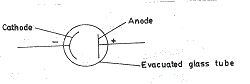
When radiation of appropriate frequency falls on the cathode (with photosensitive surface) electrons are emitted. Because the anode is positive with respect to the cathode, the electrons are attracted to the anode. The electrons flow completes the circuit and current flows.
(c)(i) Wave properties of X-rays
- diffraction
- interference
- reflection
- refraction
- polarization
(ii) Uses of X-rays other than in medicine
(d)
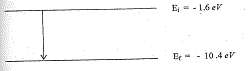
ΔE = E\(_i\) - E\(_f\)
= - 1.6 – (- 10.4)
= 8.8 e V or 1.41 x 10\(^{-18}\) J
E = hf = hc/λ
or
λ = hc/E
= 6. 6 x 10\(^{-34}\) x 3 x10\(^{8}\)

8.8 x 1.6 x 10\(^{-19}\)
λ = 1.4 x 10\(^{-7}\) m





Contributions ({{ comment_count }})
Please wait...
Modal title
Report
Block User
{{ feedback_modal_data.title }}