WAEC and NECO CBT App for Mobile Devices - Candidates, Schools, Centres, Resellers - 100% Offline -Download Now
Your School's Whatsapp Group - Join Us now

2009 WAEC Physics Theory (a)        State two essential differences between a moving coil galvanometer and a d.c. generator. (b)       ...

Physics
WAEC 2009

(a)        State two essential differences between a moving coil galvanometer and a d.c. generator.
(b)        Explain the term eddy currents and state two devices in which the currents are applied.
(c)        State the principle on which the potentiometer is based when it is functioning.
(d)       A source of e.m.f. 110 V and frequency 60Hz is connected to a resistor, an inductor and  a capacitor in series.  When the current in the capacitor is 2A, the potential differences across the resistor is 80 V and that across the inductor is 40 V.  Draw the vector diagram of the potential differences across the inductor, the capacitor and the resistor. 
Calculate the:
(i)         potential difference across the capacitor;
(ii)        capacitance of the capacitor;
(iii)       inductance of the inductor. [π = 3.14]

WAEC and NECO CBT Software for Computers and Laptops - Candidates, Schools, Centres, Resellers - 100% Offline -Download Now
Post-UTME Past Questions - Original materials are available here - Download PDF for your school of choice + 1 year SMS alerts
WAEC and NECO CBT App for Mobile Devices - Candidates, Schools, Centres, Resellers - 100% Offline -Download Now
Explanation

a)        Differences between a d. c. generator and a moving coil galvanometer.

D. C. generator moving coil galvanometer
converts mechanical energy to  electrical energy  converts electrical energy to mechanical energy.
uses split rings or commutator  uses hair springs.
rotation of coil is continuous rotation of coil is incomplete
uses carbon brushes (as terminals) uses jeweled bearings (as terminals)

(b) Eddy currents are currents induced in a conductor when subjected to varying magnetic field.                                                                                          
Any valid additional information e.g.

  • eddy current flows in a circular path or closed loops;
  • eddy current generates heat;
  • eddy current cannot flow through gaps or slots;
  • The currents move in such a direction as to oppose the change producing them.

Devices in which eddy currents are applied

  • pointers of sensitive electric meters
  • sensitive mass balances
  • brakes in large electric motors
  • speedometers in automobiles
  • detection of cracks in railway tracks
  • detection of metals

(c) Principle on which a potentiometer is based

When a steady current is allowed to pass through a uniform wire, equal lengths of the wire will have equal potential differences.

                              OR

The p.d across a length of a wire is (directly) proportional to the length provided the wire has a uniform cross section.

(d)
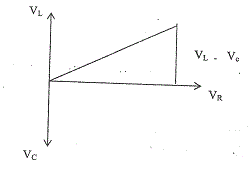
              

  Vector diagram showing
   V\(_L\)   with arrow                                                                                             
   V\(_C\)   with arrow                                                                                              
   V\(_R\)   with arrow                                                                                              
                     

(i) V\(^2\) = V\(_R^2\)  +  (V\(_L\)  - V\(_C\))\(^2\)                                                                                                         
               
    110\(^2\)   =  80\(^2\) +  (40 – V\(_C\))\(^2\)   

(40  –  V\(_C\))  =  \(\sqrt{(110 +  80) (110 – 80)}\)     

                       40 – V\(_C\)   =    +    75.5

                        V\(_C\)  =  40 +   75.5

                        V\(_C\) = 115.5V 
                                                                                               

(ii)   X\(_c\) \(\frac{V_c}{I} = \frac{1}{2 \pi f c}\)

C = \(\frac{1}{2 \pi fV_c}\)

C \(\frac{2}{2 \times 3.14 \times 60 \times 115.5} = 45.9\muF\)                     


(iii)  \(V_L = IX_L = I \times 2 \pi fL}\)

L = \(\frac{V_l}{I \times 1 \times 2 \pifVc}\)

C = \(\frac{2}{2 \times 3.142 \times 60 \times 2}\)

= 0.053H


Report an Error Ask A Question Download App
Your School's Whatsapp Group - Join Us now
Post-UTME Past Questions - Original materials are available here - Download PDF for your school of choice + 1 year SMS alerts
WAEC and NECO CBT App for Mobile Devices - Candidates, Schools, Centres, Resellers - 100% Offline -Download Now

Contributions ({{ comment_count }})

Please wait...

{{ settings.no_comment_msg ? settings.no_comment_msg : 'There are no comments' }}

Quick Questions

Post your Contribution

Please don't post or ask to join a "Group" or "Whatsapp Group" as a comment. It will be deleted. To join or start a group, please click here

{{ quote.posted_by.display_name }}
{{ settings.form_textarea_description }}
 
Post UTME Past Questions Agent
Post-UTME Past Questions - Original materials are available here - Download PDF for your school of choice + 1 year SMS alerts
Your School's Whatsapp Group - Join Us now
WAEC and NECO CBT Software for Computers and Laptops - Candidates, Schools, Centres, Resellers - 100% Offline -Download Now
WAEC and NECO CBT App for Mobile Devices - Candidates, Schools, Centres, Resellers - 100% Offline -Download Now
Your School's Whatsapp Group - Join Us now
WAEC and NECO CBT Software for Computers and Laptops - Candidates, Schools, Centres, Resellers - 100% Offline -Download Now
Post-UTME Past Questions - Original materials are available here - Download PDF for your school of choice + 1 year SMS alerts
Post UTME Past Questions Agent
