(a) State three conclusions that can be drawn from Rutherford's experiment on the scattering of alpha particles by a thin metal foil in relation to the structure of the atom
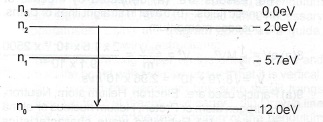
The diagram above illustrates th3 energy levels of an electron in an atom. If an excited electron moves from n\(_2\) to n\(_\theta\), calculate the:
(i) frequency;
(ii) wavelength of the emitted radiation. [ h = 6.6 x 10\(^{-34}\) Js; le V = .6 x 10\(^{-19}\) J; C = 3.0 x 10\(^8\) ms\(^{-1}\)]
(c) The following nuclear equations represent two types of radioactivity.
\(^{226}_{88}R_a \to ^{222}_{86}R_n + ^a_2a\) (Equation A)
\(^{14}_7N + ^4_2a \to ^{17}_8O + ^1_1p\) (Equation B)
Identify each type and explain briefly the difference between them
Explanation
Video Explanation
No video available
Post your Contribution
Discussions (0)
No comments yet
Be the first to comment

