(a) Give two examples each of:
(i) rotational motion;
(ii) linear motion.
(b) Describe a laboratory experiment to determine the density of an irregularly shaped solid.
(c) State Newton's second law of motion
(d) Explain the term inertia.
(e)
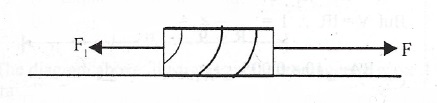
The diagram above illustrates a body of mass 5.0 kg being pulled by a horizontal force F. If the body accelerates at 2.0 ms\(^{-2}\) and experiences a frictional force of 5 N, calculate the:
(i) net force on it;
(ii) magnitude of F;
(iii) coefficient of kinetic friction. [ g = 10 ms\(^{-2}\)]
Explanation
Video Explanation
No video available
Post your Contribution
Discussions (7)

In the coefficient of kinetic friction, I think it should be frictional force/mg. Therefore it should be 5/50 and not 15/50. Since 15 Is the force required for the motion

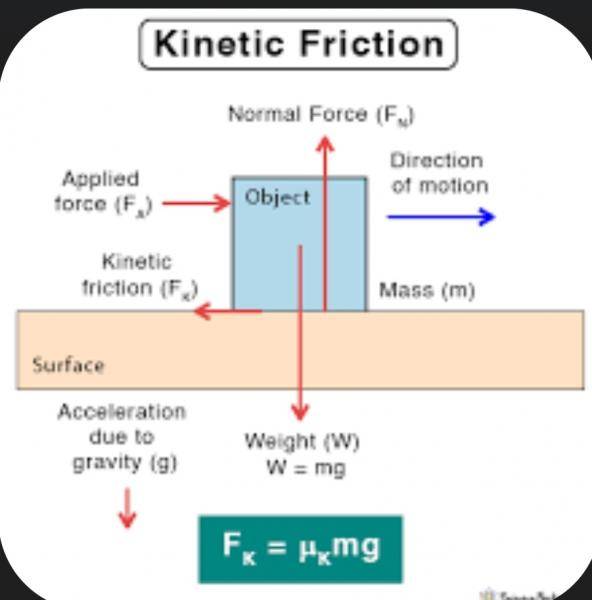
I can authoritatively tell you that the answer to (e)iii. is wrong.
That was the answer provided by WAEC, and that makes it annoying.
The coefficient of kinetict friction = kinetic friction/normal reaction.
by that, ụ = 5/50 = 0.1.
The frictional force can only be equal to the applied force only if the object is at rest (static friction) or it is moving with constant velocity (acceleration)
People should question WAEC about the nonsense they do.
Shouldn't the question e(iii) be 5/50 instead of 15/3 since 5 is the frictional force?

