(a) Define uniform acceleration.
(b) Forces act on a car in motion. List the
(i) horizontal forces and their directions;
(ii) vertical forces and their directions
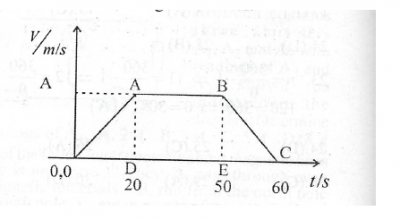
(c) A car starts from rest and accelerates uniformly for 20s to attain a speed of 25 ms\(^{-1}\). It maintains this speed for 30s before decelerating uniformly to rest. The total time for the journey is 60 seconds.
(i) Sketch a velocity-time graph for the motion.
(ii) Use the graph to determine the (\(\alpha\)) total distance travelled by the car (\(\beta\)) deceleration of the car.
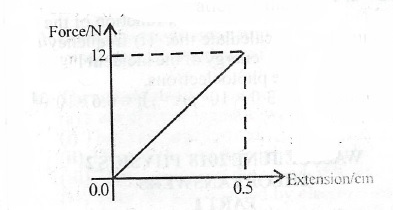
The figure above illustrates a force-extension graph for a stretched spiral spring. Determine the work done on the spring. SEE THE DIAGRAM ABOVE
Explanation
Video Explanation
No video available
Post your Contribution
Discussions (11)

Please,  , I don't know why none of the pictures offered for diagrammatic solution, in form of illustrations, of questions are not showing. Can someone help me out
  🥹???
🥹???
If an object's speed (velocity) is increasing at a constant rate then we say it has uniform acceleration.
if two forces of magnitude 2N and 3N acting at a point O are inclined at an angle of 60° to each other, find the magnitude and direction of the resultant force.?
To find the slope of a part of a graph is it not the same as the area of that part?
Like for the deceleration, can't we use area of triangle to solve for it?

