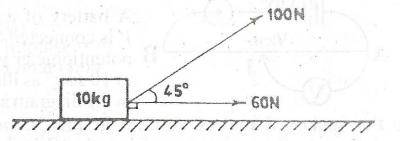
Two forces 100N and 60N act on an object of mass 10kg as illustrated in the diagram above. Neglecting friction, calculate the acceleration of the object.
4.0\(ms^{-2}\)
13.4\(ms^{-2}\)
16.0\(ms^{-2}\)
22.6\(ms^{-2}\)
Explanation
Video Explanation
No video available
Post your Contribution
Discussions (13)

Answer is B;
Solution
Resultant force F = (60+100Cos45°)N
= 130.1N
Acceleration, a=F/m
a= 130.1/10
= 13.1m/s^2
Resultant force F = (60+100Cos45°)N
= 130.1N
Acceleration, a=F/m
a= 130.1/10
= 13.1m/s^2

the My school AI. is giving different answer and the explanation too is different

Check something is wrong the answer is not there
F=ma , a= f÷m [solution ] f = 100+60 , facing the same direction the both are positive so equal to 100+60 = 160cos45
160cos 45 = 113.137085
Now you will change your kg to g,= m= 10×100 = 1000
Now apply your formula ,
Solve a =f÷m =
a = 113.137085÷1000= 0.113137085
Or a = 113.137085÷10=11.3137085