A particle of mass M initially at rest splits into two. If one of the particles of mass M1 moves with velocity V1 , the second particle moves with velocity
\(\frac{M1V1}{M-M1}\)
\(\frac{M1V1}{M1-M}\)
\(\frac{M1V1}{M}\)
\(\frac{MV}{M-M1}\)
Explanation
No explanation available
Video Explanation
Post your Contribution
Discussions (12)

The initial momentum of the particle is zero since it is at rest.
According to the law of conservation of momentum, the total momentum of the system is conserved or is always constant
The particle of mass M splits into two particles, one of them of mass M₁ with a velocity V₁.
Since we have the total mass and the mass of one of the particles, the mass of the second particle is M-M₁ moving with a velocity V₂
We are asked to calculate the velocity of the second particle V₂
According to the law of conservation of momentum
Initial momentum = Final momentum
0 = M₁V₁ + (M-M₁)V₂
M₁V₁ = -(M-M₁)V₂
M₁V₁ = (M₁-M)V₂
V₂=M₁V₁/M₁-M

answer should be A.
Because mass would split into m1 and (M-m1)
then m1×v1=(M-m1)×v2.
therefore v2=m1×v1÷(M-m1).

The answer is B. For those of you getting A, you missed a minus sign. The second velocity would be negative (assuming the first is positive)
The answer is A because sinx M2 and M1 is gotten from M then M2 = M - M1 and not M1 - M
Now just take a look at this 👇, the momentum of the ball at rest before splitting is 0 and you're saying that the ADDITION of the momentum of the two sub-particles after splitting is equal to zero!!!. You might not understand what I'm saying clearly but look at it this way; try assigning values to the masses M and M1 (of course, M would be greater than M1), also assign a velocity V1 to M1. If you should solve for the velocity of the second particle you'll get a negative answer which is not meant to be.
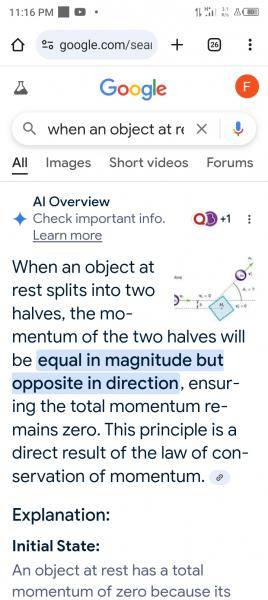
According to what I searched from Google which is posted below, the formula to be used should be:
M1•V1 = (M - M1)•V2
and not
0 = M1•V1 + (M - M1)•V2
The momentum of the two split particles are equal.
If you want to use
0 = M1V1 + (M - M1)V2
then V2 would have a negative sign to indicate that it moves in the opposite direction of V1; this should not be applied to
M1V1 = (M - M1)V2
since we are looking for the magnitude and normally velocity should be negative, it's not like acceleration and deceleration.

