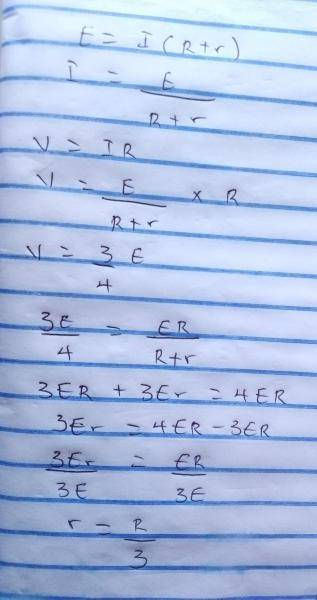
When a resistor of resistance R is connected across a.c. the terminal p.d. of the cell is reduced to three-quarter its e.m.f. The cell’s internal resistance in terms of R is
a
\(\frac{R}{4}\)
b
\(\frac{R}{3}\)
c
\(\frac{R}{2}\)
d
2\(\frac{R}{3}\)
e
R
Explanation
Correct Option
bVideo Explanation
No video available
Post your Contribution
Share:
Discussions (14)


Isabelle101
1 year ago
Guysssssss. Listen. The terminal p.d is the potential difference or work done across the terminals of a cell in delivering current to an external resistor. This is V=IR. Lost volatge is the workdone across the internal resistance of a cell. This is v=Ir.
Now, the question stated the terminal p.d is reduced to 3/4 so...
E= V+v
E= IR+Ir
IR=3/4IR + Ir
Ir= IR-3/4IR
dividing both sides by I(curent)
r=R-3/4R
r= R/4

