18.0Ω
11.0Ω
4.0Ω
2.0Ω
Explanation
Video Explanation
No video available
Post your Contribution
Discussions (9)


Solution:
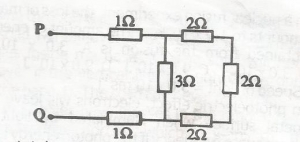
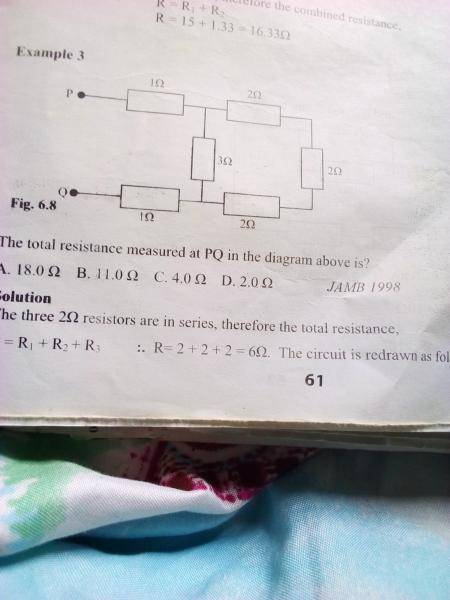
The three 2 ohms are in series, therefore the total resistance is
R=R1+R2+R3
R=2+2+2= 6 ohms.
Redrawing the circuit:
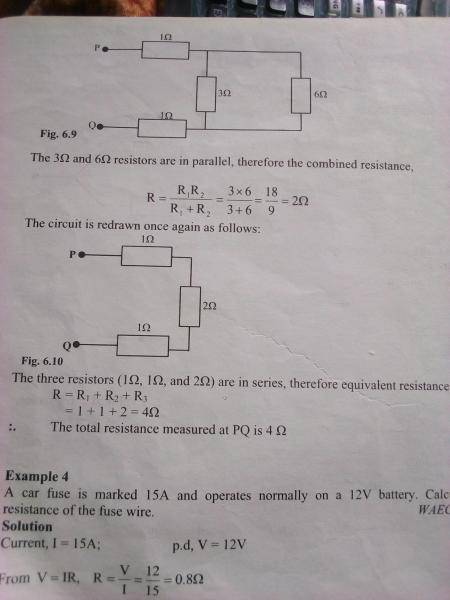
6 ohms is used to replace the three 2 ohms which is therefore placed by the 3 ohms resistor.
The 3 ohms and 6 ohms resistors are in parallel, so the combined resistance is
R=R1R2/R1+R2
R=3×6/3+6
R=18/9=2 ohms.
Redrawing the circuit again:
The 2 ohms is used to replace the 3 ohms and 6 ohms laying side-by-side.
Therefore, the 3 resistors (1ohm, 1ohm and 2 ohms) are in series.
Thus, the total resistance is
R=R1+R2+R3
R=1+1+2=4 ohms.
Therefore, the total resistance measured at PQ is 4 ohms.

An empty 60 litre petrol tank has a mass of 10kg. Its mass when full of fuel of relative density 0.72 is

