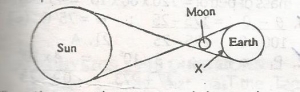
When the sun, moon and the earth are as shown in the diagram above an observer standing in X is in
Penumbra and sees a partial eclipse
Penumbra and sees a total eclipse
umbra and sees a partial eclipse
umbra and sees a total eclipse
Explanation
Video Explanation
No video available
Post your Contribution
Discussions (6)

Umbra and penumbra are two terms used to describe the shadows cast by an object during an eclipse or when light is blocked by an opaque object.
Definitions
1. *Umbra*: The umbra is the innermost and darkest part of the shadow, where the light from the source is completely blocked by the object. It's the region where the object blocks all direct light from the source.
2. *Penumbra*: The penumbra is the lighter, outer part of the shadow, where the light from the source is only partially blocked by the object. It's the region where the object only blocks part of the direct light from the source.
Key differences
1. *Intensity of shadow*: Umbra is darker, while penumbra is lighter.
2. *Light blocking*: Umbra blocks all direct light, while penumbra blocks only part of the direct light.
3. *Location*: Umbra is the innermost part of the shadow, while penumbra is the outer part.
Examples
1. *Solar eclipse*: During a solar eclipse, the Moon's umbra is the region on Earth where the Sun is completely blocked, while the penumbra is the region where the Sun is only partially blocked.
2. *Object and light source*: When an object is placed in front of a light source, the umbra is the region behind the object where the light is completely blocked, while the penumbra is the region where the light is only partially blocked.

If the arrow is correct then X is seeing a total eclipse because it pointing directly to the part blocked by the moon

