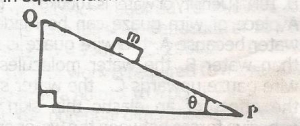
The fig above shows a block of mass m sliding down a rough inclined plane QP at angle \( \theta \) . The forces acting on the block along QP are
mg sinθ and the normal reaction
mg sinθ and the force of friction
mg sinθ and the normal reaction
mg cosθ and the normal reaction
Explanation
Video Explanation
No video available
Post your Contribution
Discussions (10)

Correct!.
The Force acting "ALONG" the plane are mgsin@ acting downward ALONG the plane and force friction (umgcos@) acting upward ALONG the plane. Option A is wrong because the Normal Reaction does not act Along the plane but acts "Normally or Perpendiculally" to the plane, therefore option *B* is absolutly correct!.

B. mg sinθ and the force of friction 
mg sinθ → Yes sir, this one is pulling the block down the slope.
Frictional force → This one is pulling the block up the slope (because it opposes motion since the plane is rough so there's friction).
Take note..... 
There are 3 main forces acting on the block:
1. Weight (mg) — Always acts straight down vertically.
2. Normal reaction — Acts perpendicular to the inclined surface.
3. Friction — Acts against the direction of motion, which means up the plane since the block is sliding down.
 mg sinθ → acts down the plane (this one pulls the block down QP)
mg cosθ → acts perpendicular to the plane (this one is balanced by the normal reaction)

The selected answer is wrong:
Mgsintheta is the frictional force acting on it then the other force mgcostheta which is the Norman reaction, so the two force acting on it are friction and normal reaction

