In the above fig, PQ and R are vectors, which of the following options, gives a correct relationship between the vectors?
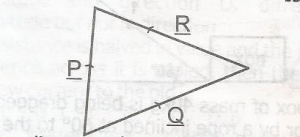
P = Q + R
P = Q - R
P = R - Q
P + Q + R = O
Explanation
Video Explanation
No video available
Post your Contribution
Discussions (26)

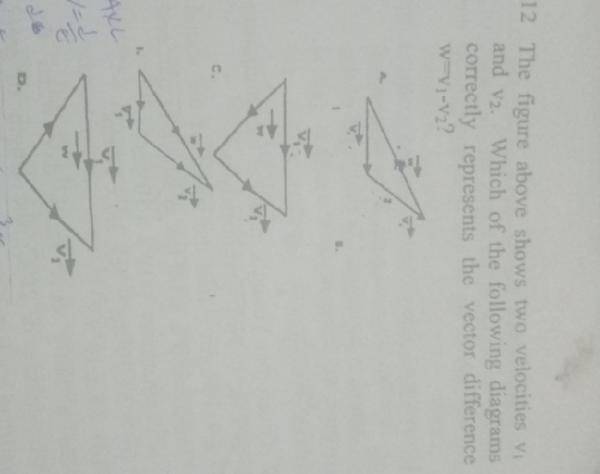
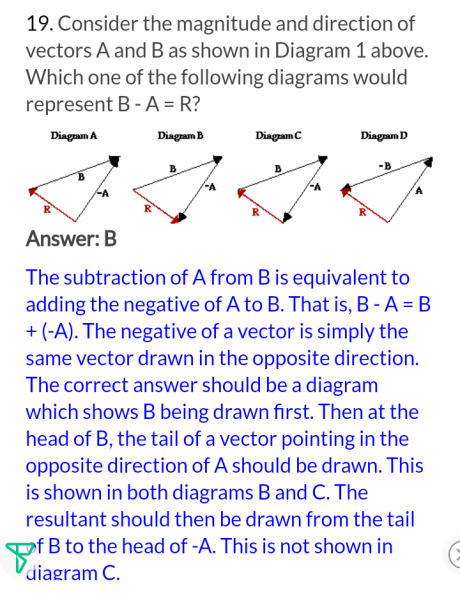
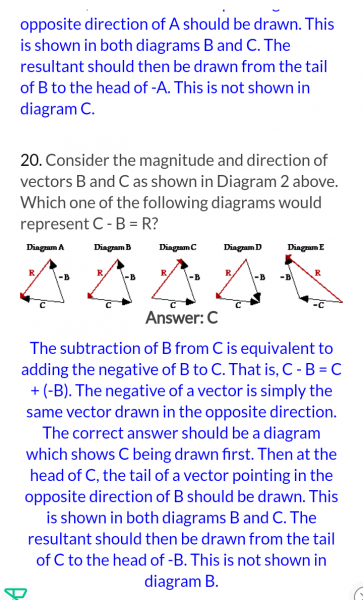
 My guys listen my school is very correct, A is very corect. It is when the arrows are moving in the same direction thats when the sum of the three vectors = zero, in the d diagram Q and R is in the same direction but P is in diffrent direction and represent the resultant, pls take note if u are ask to find the resultant of three vector, the resultant should be facing another direction, while the other two should be in the same direction. I've also seen similar question in jamb 2003, and the question was like find w= V1-V2?, it took me time to realise that they are still saying the same thing the w is the resultant acting in different direction while V1 and V2 is moving in d same direction
the answer is C for 2003 , in the image I post and the one in question is A which is P= Q + R. pls some of the answer u see online may be due to errors in the diagrams. I rest my case.
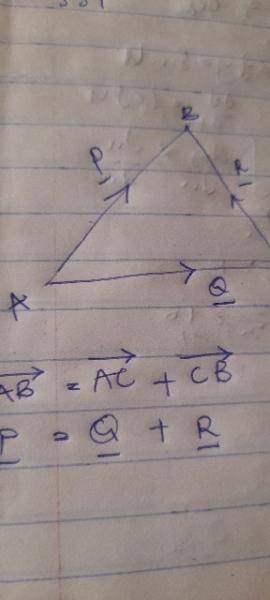

The selected answer is wrong. The correct option is D. These are not vectors on a straight line, so P cannot be equal to Q+R
The algebraic sum of all the resolved forces must be zero. Therefore, P+Q+R =0
P = -(Q+R)

that is the answer though
if u watch closely u will discover that the arrows indicating P and Q both emanated from the same origin ie they started from the same point. we call that origin from where they started from "the head". and if u observe very well again u will notice that R started from the tail of Q. so the sum of the sides that applies to rule is equal to zero. had it been that arrow P was moving downward to meet the head of P u would have sumed it up to zero (P+Q+R = 0). but because only Q and R obeyed the rule and P disregarded the rule, the answer suppose is to be P = Q+R. thanks
the correct ans here is B no offense but are u guys like blind. NWESE in his explanation said, the ans is not D cuz the vectors are not in the same direction, its A because P which is the resultant is in the oppsite direction as R and Q NWESE still post images explaining this. so biko why is the ans P=Q+R not P=Q-R. the head of P is clear opposite the head of R which should make is negative not positive. look at the explanation and question very well please thank you.
It wrg,,,,,the right ansa is D,,,,,the sum of the resultant force is equal to zero

