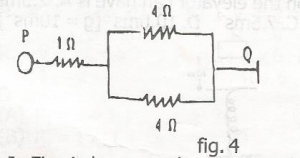
In the above, a voltage V is applied across the terminals P and Q. The voltage across the 1 ohm resistor is
V/8
V/4
V/3
V/2
Explanation
Video Explanation
No video available
Post your Contribution
Discussions (11)

I think the question should be current and not voltage
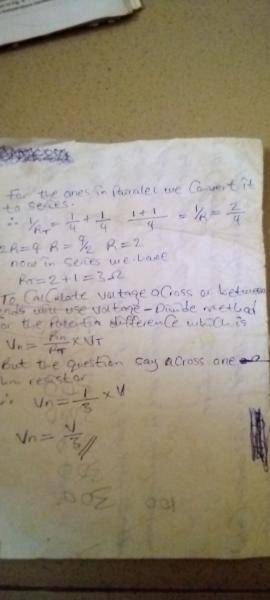
Effective resistance R= (1/R = 1/4 + 1/4) + 1
R =3
Using V=IR
V=3I
I = V/3
i want to complain to my skool.
most times when practicing cbt, diagrams dont come up in my questions and i dont find it funny because i just have to guess the answer and most times i guess wrong.
can u correct it or is the problem from me

I think the question should be current and not voltage
Effective resistance R= (1/R = 1/4 + 1/4) + 1
R =3
Using V=IR
V=3I
I = V/3

solution
data given:
C1 = 1ohm
C2 = 4ohm
C3 = 4ohm
current, I = ???
for resistors connected in parallel.
the effective resistors is given by
1/R = 1/C2 + 1/C3
1/R = 1/4 + 1/4
1/R = 2/4
invert (cross and multiply ✖️)
2R = 4
R = 2ohm
for resistors connected in series
is just 1ohm
therefore to find total resistors, u add both the parallel and the series connection together.
for parallel = 2ohm
for series. = 1ohm
total resistors, R = 2+1 = 3ohms
total R = 3ohms.
recall:
V = IR
making I the subject
I = V/3
so oo option C is very correct 💯.



