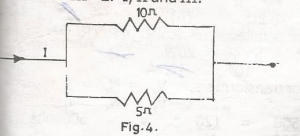
In the Fig above, Current I passes through the combination, if the power dissipated in the 5 ohm resistor is 40W, then the power dissipated in the 10 ohm resistor is


Since the resistors are in parallel, the p.d across them is the same,
P = VI but I = \(\frac{ V}{R}\)
P = \(\frac{ V^2}{R}\) = power dissipated by 5Ω resistor,
40 = \(\frac{ V^2}{5}\)
\(V^2\) = 200V.
Power dissipated by the 10Ω resistor,
P = \(\frac{ V^2}{R}\) = \(\frac{200}{10}\)
P = 20W.





Contributions ({{ comment_count }})
Please wait...
Modal title
Report
Block User
{{ feedback_modal_data.title }}