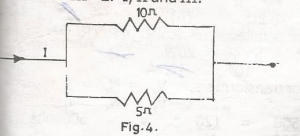
In the Fig above, Current I passes through the combination, if the power dissipated in the 5 ohm resistor is 40W, then the power dissipated in the 10 ohm resistor is
10W
20W
40W
80W
100W
Explanation
Video Explanation
No video available
Post your Contribution
Discussions (17)

Since in a parallel connection there is different current but same voltage in the circuit.
Where P1= V²/R
40 = V²/5
Then V²=200v
Since same voltage is applied
P = 200/10
P = 20W

Power Dissipated=I
2
×R
Given that the current
�
I in both resistors are different, but from
�
=
�
�
V=IR, we have
�
=
�
�
I=
R
V
.
Substituting
�
=
�
�
I=
R
V
into the previous formula, we get:
Power Dissipated
=
(
�
2
×
�
�
2
)
Power Dissipated=(
R
2
V
2
×R
)
Power Dissipated
=
�
2
�
Power Dissipated=
R
V
2
Given that
40
=
�
2
5
40=
5
V
2
in the
5
Ω
5Ω resistor, we can solve for
�
2
V
2
:
�
2
=
40
×
5
=
200
V
2
=40×5=200
�
=
200
V=
200
Then, the power dissipated in the
10
Ω
10Ω resistor is:
Power Dissipated
=
�
2
�
=
(
200
)
2
10
=
200
10
=
20
watts
Power Dissipated=
R
V
2
=
10
(
200
)
2
=
10
200
=20 watts
So, option B is correct.

Power Dissipated = I^2 x R
but the current, I in the both resistors are different but from V=IR
I = V/R
Then put in the previous formula, we should have (V^2 x R) / R^2
then 40 = V^2/5
V^2 = 200
V = √200
For the 10 ohm resistor, the power dissipated is V^2/R
= ((√200)^2)/10
= 200/10
= 20 watts
That is option B


