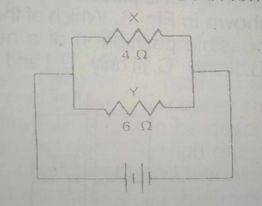
In the diagram above, X and Y have resistances 6 and 4 ohms respectively, if the power dissipation in X is 10W then power dissipation in Y is
2.4W
4
6.0W
6.7W
15.0W
Explanation
Video Explanation
No video available
Post your Contribution
Discussions (30)

E is correct ✔️
The diagram that's not there is showing a parallel connection..
P=V2/R
10=V2/6
V2=60V
Recall that parallel connection involve same voltage different current..
So,
P=V2/R
P=60/4
P=15W✔️
Solution
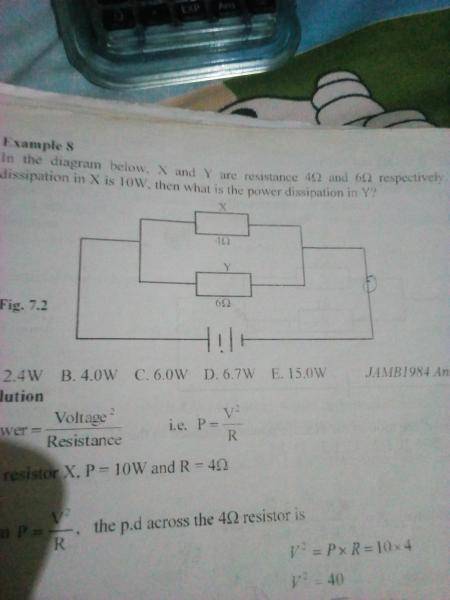
Power= Voltage^2/resistance
For the resistor X, power is 10W and resistance is 4 ohms
From the formula Power= voltage^2/resistance, the potential difference (V) across the 4 ohm resistor is V^2=P×R
V^2=10×4=40
V=✓40=6.32V
Note that the potential difference across resistor Y is also 6.32V because all resistors connected in parallel have the same potential difference.
Therefore, for the resistor Y
V=6.32V and R=6V
P=V^2/R
P=6.32^2/6= 6.7W
Therefore, the power dissipated in resistor Y is 6.7W (D)


 @Myschool
my school please make corrections, E.15W is correct
in parallel connection, current is not constant rather voltage is constant.
you using p=I²R is just like saying I=p/R which will give you 6.7w. which is very wrong because current is not constant in parallel.
using P=V²/R is correct because constant variable V is in this formula.
p/R=V²
using this will give you
px/Rx=Py/Ry
10/4=py/6
6*10/4=60/4=15W
Note, in questions like this..
parallel=P=V²/R (V is constant)
Series=P=I²R (I is constant).


MYSCHOOL pls correct this, the answer is D) 15
It was literally stated in the question that Px =6 and Rx =10 while Ry = 4 and Py= ???
why do you guys twist the values??
pls correct this
Which rubbish diagram is above??????????????????????????
I cant see anything diagram oh and this is not the first time.

