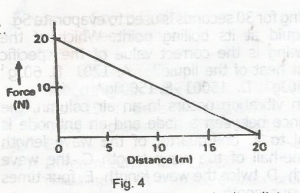
A force varying linearly with the distance acts on a body as shown above, The work done on the body by the force during the first 10m of motion is
100J
150J
200J
300J
600J
Explanation
Video Explanation
No video available
Post your Contribution
Discussions (21)

In work, another way to get your answer is using the area of the shape of your graph and if you look at this graph clearly on the 10m mark you'll see that it forms a square with the 10 N mark
and work= Force x distance
10N X 10m = 100J
there are two ways of solving it its either you get the work done by finding the area of the graph taking note of the distance 10m not 20m "it is very important to read the question properly before attempting it ". the other way is by using yhe formula for workdone in an elastic spring which is W=1/2 ×F×E where f is force and e is extension which both correspond to yhe intercept in the graph unless stated otherwise in this case e is not the intercept so we use the e give in the question .
i hooe its explanatory enough
the work done is the same as the area of the shape formed by joining the two points involved. In joining the two points (x&y, which correspond to 10m on the horizontal axis and 20N on the vertical axis) we obtain a triangle of height 20N and base 10m.Area of triangle=1/2 ×b ×h
1/2×20×10=100j
Area under the force-distance graph is a trapezium, meaning the answer is 150J not 100J.
Myschool please correct this.

To find the work done by the force in the first 10 m, we calculate the area under the force-distance graph from 0 to 10 m.
Since the force decreases linearly from 20 N to 10 N over the first 10 m, the area under the graph forms a trapezium.
The formula for the area of a trapezium is:
Area = 1/2 × (F1 + F2) × distance
Here, F1 = 20 N, F2 = 10 N, and distance = 10 m.
So,
Work = 1/2 × (20 + 10) × 10 = 1/2 × 30 × 10 = 150 J
Therefore, the correct work done is 150 joules, not 100 J. If your answer was 100 J, you might want to revisit the area of a trapezium, not the laws of physics 😌

guys you're right to use area but you forget something the first 10m of motion doesn't start with a force of 0 it starts with 20 then goes down to 10 in the first 10 metres the shape used should not be the down trapezium but the upper triangle between 20N to 10N and 0m to 10m so it should be 1/2 bh for triangle thats 1/2× 10×20 that should give 100m
According to the results,I didn't attempt any questions under physics which is a lie

The figure described by the motion is a trapezium
=1/2(20+10)×10=15×10=150J

