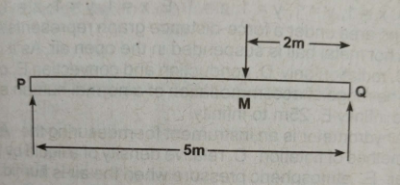
A Uniform beam PQ of mass 20kg and length 5m is balanced as shown above, a man of weight 800N stands at M such that QM = 2m. The reaction at P and Q respectively are(take g = 10ms-2)


The downward forces acting on the system are the weight of the man (800 N) and the weight of the beam (200 N). Thus, the total downward force is:
\(800 \, \text{N} + 200 \, \text{N} = 1000 \, \text{N}\)
The total upward forces are represented by reactions \( P \) and \( Q \):
\(P + Q = 1000 \, \text{N}\)
Since the beam is uniform, its weight acts at the center, which is located 2.5 m from either end.
To satisfy the condition of equilibrium, the total clockwise moments must equal the total anticlockwise moments. Taking moments about point \( Q \):
\((200 \, \text{N} \times 2.5 \, \text{m}) + (800 \, \text{N} \times 2 \, \text{m}) = P \times 5 \, \text{m}\)
Calculating the moments:
\(500 \, \text{N}\cdot\text{m} + 1600 \, \text{N}\cdot\text{m} = 5P\)
This simplifies to:
\(2100 \, \text{N}\cdot\text{m} = 5P\)
Solving for \( P \):
\(P = \frac{2100}{5} = 420 \, \text{N}\)
Now, substituting \( P \) back into the upward force equation:
\(420 \, \text{N} + Q = 1000 \, \text{N}\)
Solving for \( Q \):
\(Q = 1000 - 420 = 580 \, \text{N}\)
Thus, the reactions at \( P \) and \( Q \) are: 420N and 580N respectively.





Contributions ({{ comment_count }})
Please wait...
Modal title
Report
Block User
{{ feedback_modal_data.title }}