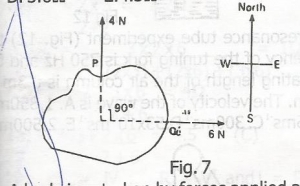
A body is acted upon by forces applied at points P and Q as shown above their resultant is equal to
2√5N in adirection N 56◦ E
2√5N in adirection N 56◦ W
2√13N in adirection N 56◦ E
2√13N in adirection N 56◦ W
√10N in adirection N 56◦ E
Explanation
Video Explanation
No video available
Post your Contribution
Discussions (15)

Let's break down this physics problem step-by-step to understand why option C (2√13 N in direction N 56° E) is the correct answer.
We have two forces acting on a body:
* Force at P: 4N acting vertically upwards (North)
* Force at Q: 6N acting horizontally to the right (East)
We need to find the resultant force, which is the single force that has the same effect as these two forces combined.
Solving the Problem:
* The 4N force points straight up, and the 6N force points straight to the right. They form a right angle.
* Finding the Magnitude (Size) of the Resultant:
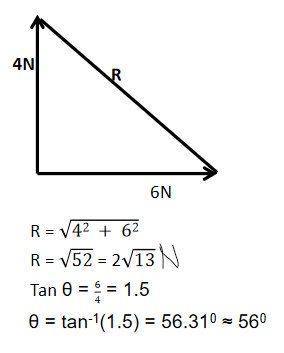
* We can use the Pythagorean theorem because the forces form a right triangle.
* Let 'R' be the magnitude of the resultant force.
* R² = (4N)² + (6N)²
* R² = 16 + 36
* R² = 52
* R = √52
* R = √(4 * 13)
* R = 2√13 N
* Finding the Direction of the Resultant:
* We need to find the angle (let's call it θ) the resultant force makes with the horizontal (East).
* We can use trigonometry: tan(θ) = (opposite side) / (adjacent side)
* tan(θ) = 4N / 6N = 2/3
* θ = arctan(2/3) arctan is the inverse tangent( this is because my keyboard cannot do tan inverse so I used arctan. They mean the same thing)
* θ ≈ 33.69°
* However, the answer choices give the direction as an angle measured from the North. So, we need to find the complementary angle:
* 90° - 33.69° ≈ 56.31°
* Since the resultant force is in the quadrant where both North and East are positive, the direction is North 56° East (N 56° E).
Therefore, the correct answer is C: 2√13 N in direction N 56° EI just hope this is clear. 😊


Sorry for the last part it is "Therefore the correct answer is C: 2√13 N in the direction N 56° E".
I meant to write"I just hope this is clear".
Pardon my mistake 👍
Should incase you don't know how to calculate the tan inverse of 4/6
after solving for the resultant,look out for the option which has the same value as the resultant and also travels in a North East direction.
Obviously you'll discover that C is the correct option

