in a light experiment with a convex lens a student plotted a graph as shown above of the reciprocal of object distance (1)/u against the reciprocal of image distance (1)/v . the focal length of the lens is given as
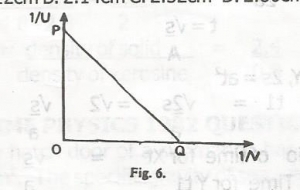
slope of line PQ
Reciprocal of either OP or OQ
Length OP or OQ
area under the graph E ratio OP/OQ
Explanation
Video Explanation
No video available
Post your Contribution
Discussions (9)

omo be like if this question come out i go skip am this one everybody dey argue the answer

lets clear the don't
this is a very forward question.
u know that:
lens formula = 1/f = 1/u + 1/v
graph is 1/u vs 1/v
so oo when 1/v = 0, 1/u = 1/f
that is OP
again when 1/u =, 1/v = 1/f
that is OQ
that means if 1/u = 1/f
and. 1/v = 1/f
therefore 1/f = OP = OQ
f = reciprocal of OP or OP
so ooo option B is exceptional.
just understand the concept.



