A uniform bean HK of length 10m and weighing 200N is supported at both ends as shown above. A man weighing 1000N stands at a point P on the beam. If the reactions at point H an K respectively are 800N and 400N, Then the distance HP is
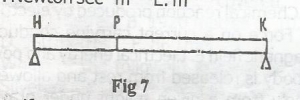
4m
3.5m
3m
\( 6 \frac{2}{3} \)m
7m
Explanation
No explanation available
Video Explanation
No video available
Post your Contribution
Discussions (15)

Let the centre be 5m
Taking moment abt the point
Weight of the man=1000N
Distance of the man from the centre=x
Force acting at k end=400N
Distance between the centre and k end=5m
1000*x=400*5
1000x=2000
X=2000/1000=2m
Therefore the remaining side hp=5-2=3m

taking moment about H
(1000*hp) + ( 200*5)= (400*10)
1000hp + 1000= 4000
1000hp = 4000-1000
1000hp =3000
hp = 3000/1000
hp = 3cm
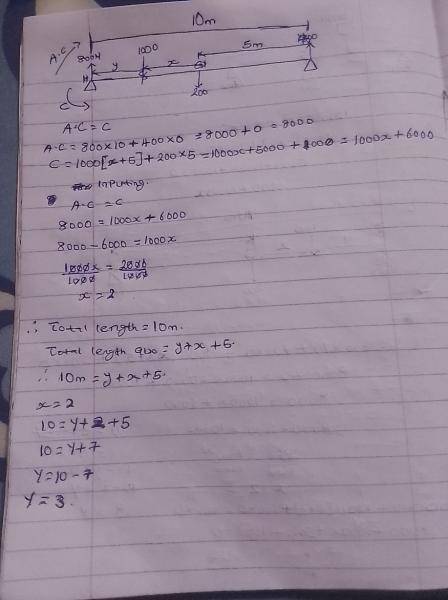
Based on my interpretation of the information, I would set the problem up like this:
x = distance HP from H to the 1000 N man
Put the 200 N weight of the beam through the center of mass at 5m (length = 10 m)
In clockwise direction, the net torque about point H must be zero to be in equilibrium:
τH = x(1000 N) + (5m)(200 N) - (10 m)(400 N) = 0
(Note the force applied at point H does not contribute to the torque about H.)
x = (10*400 - 5*200) / 1000 m = 3 m
We can check this by calculating torque about K in the same way:
(800 N)(10 m) - (200 N)(5 m) - (1000 N)(10m - x) = 0
10 - x = (800*10 -200*5) / 1000 = 7m
Then x = 10-7 m = 3m, so it checks out
let me try
let's start by ....
(1000xhp) + ( 200x5)=(800x0) + (400x10)
1000hp + 1000= 4000
1000hp =3000
divide both sides by 1000
hp = 3000/1000
hp = 3m

