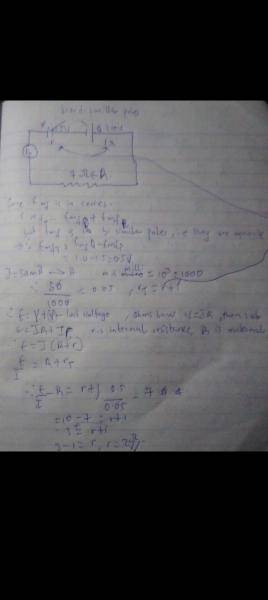
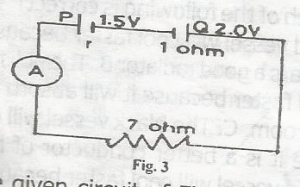
In a given circuit, the cell P has an emf 1.5V and an unknown internal resistance while cell Q has an emf 2.0V and an internal resistance of 1 ohm if the ammeter reads 50m A, Then r is equal to
0.5 ohm
0.62 ohm
1.0 ohm
2.0 ohm
3.0 ohm
Explanation
Video Explanation
No video available
Post your Contribution
Discussions (35)

Jamb 1979: in the circus below the cell P has an e.m.f 1.5v and an unknown internal resistance of r while the cell Q has an e.m.f of 2.0v and an internal resistance of 1ohms if d ammeter reads 50mA, then r equals?
Here is a simple way
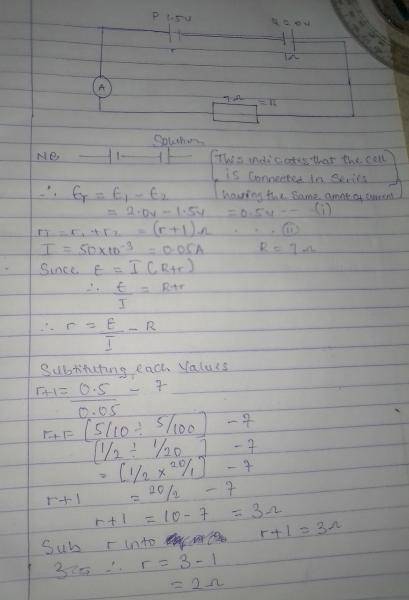
E-v=I(R+r+r)
1.5-2=50x10^-3(7+1+r)
0.5v=0.05amp(8+r)
Expand
0.05amp(8 + r)
0.5v=0.4+0.05r
Find r
0.5-0.4=0.1
0.1/0.05=2
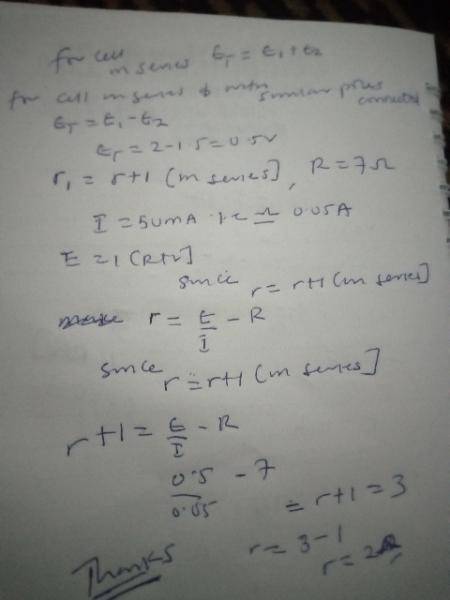


Thanks for the explanations.....But I think the best way of knowing this thing better ...is by checking the different contributions made by others and finally meditating specifically on that of Shile method...Thanks


The unknown internal resistance (r) of cell P is 2.0 ohms. This corresponds to option D in the provided image.
To calculate the internal resistance, the following steps can be used:
1. Calculate the total resistance in the circuit:
Total resistance (R) = External resistance + internal resistance of cell Q + internal resistance of cell P
R = 7 ohms + 1 ohm + r = 8 + r
2. Apply Ohm's Law:
Total voltage (V) = Current (I) * Total resistance (R)
The total voltage in the circuit is the difference between the EMFs of the two cells since they are connected in opposition: V = 2.0V - 1.5V = 0.5V
Convert the current from milliamperes to amperes: I = 50 mA = 0.05 A
0.5V = 0.05A * (8 + r)
3. Solve for r:
0.5 = 0.4 + 0.05r
0.1 = 0.05r
r = 0.1 / 0.05
r = 2.0 ohms