Thermal energy
thermal conduction
heat loss
specific heat capacity
thermal capacity
Explanation
No explanation available
Video Explanation
No video available
Post your Contribution
Discussions (8)

The correct answer is **E. thermal capacity**.
Thermal capacity of a body is the amount of heat energy required to raise its temperature by one degree. It depends on the mass and the material of the body. It's important to note that specific heat capacity (option D) is related but it's the amount of heat required to raise the temperature of one kilogram of the material by one degree. So, it doesn't depend on the mass of the body. The other options (A, B, C) are not directly related to the amount of heat required to raise the temperature of a body. Therefore, the answer is E. thermal capacity.


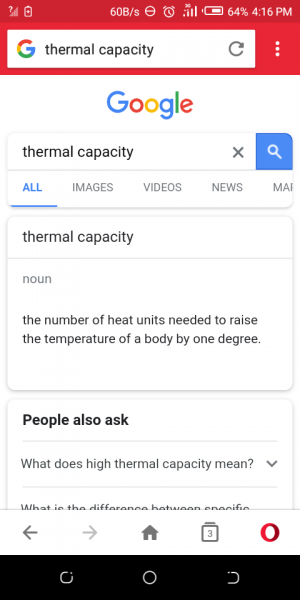
Thermal capacity (or heat capacity) is the amount of heat required to raise the temperature of a body by 1°C (or 1 K).
Formula:
� = thermal capacity
� = heat supplied
� = temperature change
Other options:
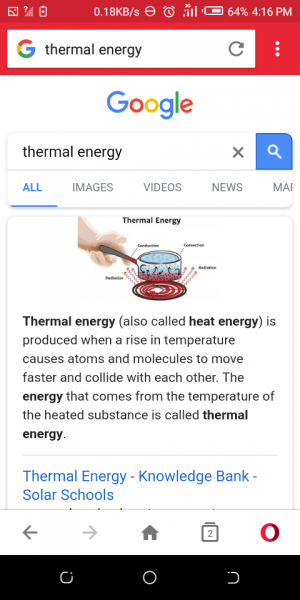
A. Thermal energy → total energy in the form of heat in a body, not the specific amount to raise temperature.
B. Thermal conduction → process of heat transfer through a material.
C. Heat loss → heat lost from a system.
D. Specific heat capacity → heat required to raise 1 kg of a substance by 1°C; similar but per unit mass, not the whole body.
Key point: Thermal capacity = heat required to raise the temperature of the entire body, while specific heat capacity is per kilogram.

The answer is A.The difference between thermal energy and thermal capacity is 1K

