In a fission process, the decrease in mass is 0.01%. How much energy could be obtained from the fission of 0.1g of the material
\( 9.0 \times 10^{9}J \)
\( 9.0 \times 10^{10}J \)
\( 6.3 \times 10^{11}J \)
\( 9.0 \times 10^{11}J \)
Explanation
Video Explanation
No video available
Post your Contribution
Discussions (21)
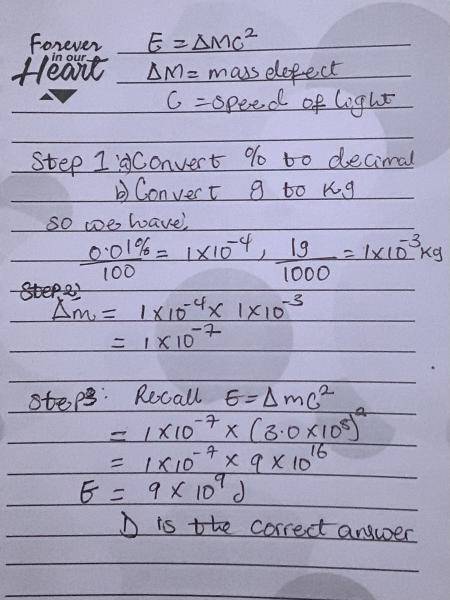

The correct answer is B
E = ∆mc²
But ∆m is 0.01 × 0.1×10*-3 kg
Which gives 1×10*-6
E = 1×10*-6 × (3×10*8)²
E= 9×10*10
To solve this, we'll use Einstein’s mass-energy equivalence formula:
E = \Delta m c^2
Where:
= energy released (in joules),
= decrease in mass (in kg),
= speed of light = .
---
Given:
Mass of material:
Decrease in mass:
So, the actual decrease in mass is:
\Delta m = 1.0 \times 10^{-4} \times 1.0 \times 10^{-4} = 1.0 \times 10^{-8} \, \text{kg}
Plug into Einstein's equation:
E = (1.0 \times 10^{-8}) \times (3.0 \times 10^8)^2
E = 1.0 \times 10^{-8} \times 9.0 \times 10^{16}
= 9.0 x10^8

@Myschool it seems like you made a mistake.
From my research, this question is from the 2003 JAMB Chemistry
Where Δm is the mass defect, and C is the speed of light.
Therefore
Δm=0.01×0.1g=1.0×10−4=1.0×10⁻⁶kgEnergy Released =ΔMC2=1.0×10−6×(3.0×108)2=1.0×10−6×9.0×1016=9.0×10*10J