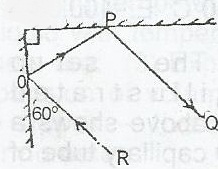
Two mirrors are inclined as shown in the diagram. A ray of light RO strikes the arrangement at O and emerges along PO. The emergent ray has been deviated through
240o
180o
120o
60o
30o
Explanation
No explanation available
Video Explanation
No video available
Post your Contribution
Discussions (9)


Awfa, my school, you guys should always show explanations for the questions naa
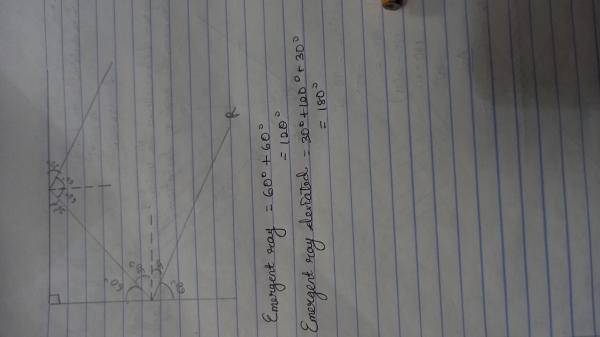
Now I don't even know how you guys arrived at 180°
I thought the formula to use for this is d=180-(I+r)?
Thank you for providing the diagram.
To determine the deviation of the emergent ray from the incident ray, we need to apply the laws of reflection.
Let's consider the path of the light ray from O to P. When the incident ray RO strikes the first mirror, it reflects according to the law of reflection, which states that the angle of incidence is equal to the angle of reflection. Therefore, the angle of incidence i1 is equal to the angle of reflection r1, as shown in the diagram.
Similarly, when the reflected ray QO strikes the second mirror, it reflects again according to the law of reflection. The angle of incidence i2 is equal to the angle of reflection r2.
Now, we need to find the angle between the reflected ray QO and the emergent ray PO. Let's call this angle x.
From the diagram, we can see that the angles r1 and i2 are alternate angles, which means they are equal. Therefore, we can write:
r1 = i2
Similarly, the angles r2 and x are alternate angles, so:
r2 = x
Now, we need to find the value of r1 and r2. We can use the fact that the sum of the angles in a triangle is 180 degrees. Therefore:
r1 + i1 + 90 = 180 (angles in triangle OAB)
r2 + i2 + 90 = 180 (angles in triangle ABC)
Simplifying these equations, we get:
r1 + i1 = 90
r2 + i2 = 90
We know that i1 = 70 degrees (given in the diagram). Therefore:
r1 = 90 - i1 = 90 - 70 = 20 degrees
Similarly, we can find i2 using the fact that the angle AOB is a straight line (180 degrees):
i2 + r2 + 70 = 180
i2 + r2 = 110
We also know that r1 = i2. Therefore:
2i2 = r1 + r2
2i2 = 20 + r2
Substituting this into the previous equation, we get:
20 + r2 + r2 = 110
2r2 = 90
r2 = 45 degrees
Now we have the values of r1 and r2, so we can find x:
x = r2 = 45 degrees
Therefore, the emergent ray has been deviated through an angle of 45 degrees from the incident ray.

