charges generated on glass rubbed with silk are called negative
charges in various media can be carried by protons detached from their atom
the magnitude of any charge is a multiple of the charge of an electron
the intensity of an electric field is a scalar quantity
if 500 joules of work are required to move a 2-coulomb charge between two points, the potential difference between the two point is 100V
Explanation
No explanation available
Video Explanation
No video available
Post your Contribution
Discussions (27)

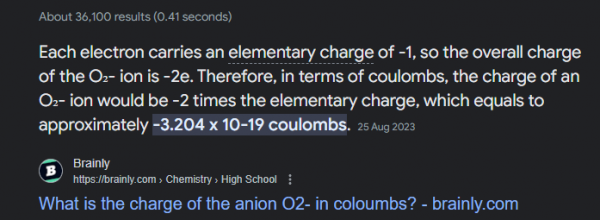
okay let me explain each option and why C is the correct one
First option A (charges generated on glass rubbed with silk are called negative)
first they are not called negative, the glass gains the postive charge while the silk gains the negative charge
For Option B (charges in various media can be carried by protons detached from their atom)
while this is partially wrong is because protons are strongly bound to the nucleus, Protons are part of the nucleus of an atom, along with neutrons. The nucleus is very dense and has a strong force called the strong nuclear force holding protons and neutrons together. It takes a tremendous amount of energy to remove a proton from an atom.
For Option D (the intensity of an electric field is a scalar quantity)
we all know this is a vector quantity infact all fields are vector quantity
For Option E (if 500 joules of work are required to move a 2-coulomb charge between two points, the potential difference between the two point is 100V)
we were give W = 500j and Q = 2C
W = QV
V = W/Q
V = 500/2
V = 250v
so the correct potential difference ought to be 250v not 100v so this statement is wrong leaving only Option C
here is why C is correct
this is because of a fundamental principle in physics called charge quantization which states that the electric charge of any object must be an integer multiple of a fundamental unit called the elementary charge (represented by the symbol 'e'). 'e' has a value of approximately 1.602 x 10^-19 coulombs
For example an electron carries a negative charge of -1 'e'.
A proton carries a positive charge of +1 'e'.
An oxygen ion (O2-) might carry a negative charge of -2 'e'
for oxygen ion:
Elementary charge (e) ≈ 1.602 x 10^-19 coulombs
Charge of an oxygen ion (O2-): -2 * e (since it has gained two electrons)
Magnitude of the oxygen ion's charge: |-2 * e| = 2 * |e| ≈ 3.204 x 10^-19 coulombs
Therefore, the magnitude of the oxygen ion's charge is indeed a multiple of the elementary charge, following the principle of charge quantization.


All of u here should greet ur children for me , coz by now una don marry by now sef.
hope you later scored upto 300 in utme. bcuz your comments just dey everywhere.
The charge of the electron is equivalent to the magnitude of the elementary charge (e) but bearing a negative sign. Since the value of the elementary charge is roughly 1.602 x 10⁻¹⁹ coulombs (C), then the charge of the electron is -1.602 x 10⁻¹⁹ C.


thanks to all that ev contributed, but those of you guys that are on this link b4now hw do you became so perfect?


I think option e too is correct because p. d is constant if they are been connected in parallel


