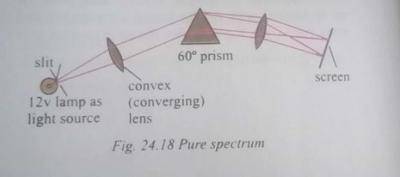
Which of the following arrangements in the sequence shown can be used to obtain a pure spectrum of white light?
source, slit, converging lens, prism, converging lens, screen.
source, slit, diverging lens, prism, diverging lens, screen.
source, converging lens, prism, diverging lens, screen.
source, slit, prism, diverging lens, converging lens, screen.
source, slit, prism, diverging lens, sreen.
Explanation
Video Explanation
No video available
Post your Contribution
Discussions (6)

Just cram ( school should let parents learn something)
source , slit lens, prism ,lens , screen
am remember it uses converging lens
try it

To obtain a pure spectrum of white light, we need to ensure that the different wavelengths of light are well separated and focused properly on a screen without overlapping. This requires:
1. A narrow slit – to ensure that the incoming light is collimated (parallel rays).
2. A converging lens – to focus the collimated light onto the prism.
3. A prism – to disperse the light into its constituent wavelengths (spectrum).
4. A second converging lens – to focus the dispersed light onto a screen, ensuring a well-separated pure spectrum.
Now, let’s analyze the given options:
Option A:
source → slit → converging lens → prism → converging lens → screen
 This setup is correct. The slit ensures collimation, the first converging lens helps focus the light before dispersion, the prism disperses it, and the second converging lens ensures the dispersed light is focused on the screen to form a pure spectrum.
Option B:
source → slit → diverging lens → prism → diverging lens → screen
 A diverging lens spreads the light rather than collimating it, which does not ensure proper dispersion. This would not give a pure spectrum.
Option C:
source → converging lens → prism → diverging lens → screen
There is no slit to collimate the light, and the diverging lens after the prism would spread out the dispersed light, making it unfocused.
Option D:
source → slit → prism → diverging lens → converging lens → screen
The slit is good, but the prism directly after it would not receive collimated light. The diverging lens would further spread the dispersed light, preventing a pure spectrum.
Option E:
source → slit → prism → diverging lens → screen
Same problem as Option D. The diverging lens does not help in focusing the spectrum correctly.
Final Answer: A
Only Option A correctly follows the required sequence to obtain a pure spectrum of white light.


