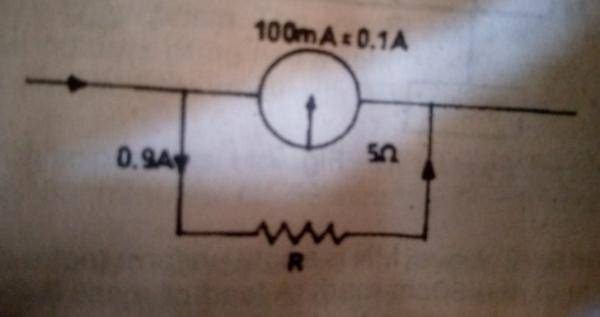
A galvanometer of resistance 5.0Ω has full-scale deflection for a current of 100mA. How would its range be extended to 1.0A? By placing a resistance of
\(\frac{5}{9}\)\(\Omega\) in parallel
\(\frac{9}{5}\)\(\Omega\) in series
45\(\Omega\) in parallel
45\(\Omega\) in series
\(\frac{9}{5}\)\(\Omega\) in parallel
Explanation
Video Explanation
No video available
Post your Contribution
Discussions (11)

The ans is A
IgRg=IsRs
Ig=100ma=0.1A
Rg=5
Is=I-Ig=1-0.1=0.9
IgRg=IsRs
0.1*5=0.9*Rs
Rs=0.1*5/0.9=0.5/0.9=5/9

Myschool please review the question again coz the selected answer is wrong
R=Igrg/I-Ig
where Ig=current of the galvanometer
rg=internal resistance of the galvanometer
Ig=100mA=100/1000=0.1A
rg=5ohms
I=1A
R=??
R=5*0.1/1-0.1
=0.5/0.9ohms
Multiply the denominator and numerator by 10
R=0.5*10/0.9*10
=5/9 in parallel
this means that a resistance of 5/9ohms is connected in parallel to the galvanometer




some of the diagrams are not clear enough,and the letters in the diagram are negligable.why some are not properly written.but the exam is very encouraging
I USED TO TELL PEOPLE THAT YOU ARE ABOVE MISTAKE UNTIL TODAY
Myschool please review the question again coz the selected answer is wrong❗
R=Igrg/I-Ig
where Ig=current of the galvanometer
rg=internal resistance of the galvanometer
Ig=100mA=100/1000=0.1A
rg=5ohms
I=1A
R=??
R=5*0.1/1-0.1
=0.5/0.9ohms
Multiply the denominator and numerator by 10
R=0.5*10/0.9*10
=5/9 in parallel
this means that a resistance of 5/9ohms is connected in parallel to the galvanometer
but you said it was 9/5

