A lens of focal length 12.0cm forms an upright image three times the size of a real object. The distance between the object and the images is
8.0cm
16.0cm
24.0cm
32.0cm
Explanation
Video Explanation
No video available
Post your Contribution
Discussions (16)

Upright image is a virtual image and always negative.
If de obj size(U) = X; den de image size(V) = -3X; the focal length(given),F=12.....den using lens formula:
(1/F) = (1/U) + (1/V); (1/12)=(1/x) + (- 1/3x);
(1/12)=(1/x) - (1/3x); (1/12)=(2/3x)
Den, X=8..
Did means dat, U=x=8cm and V= -3X= -24cm.
Wen image is formed on de same side as de obj, de distance between dem is the difference in their sizes. So in lens virtual image are formed on de same side with the object. Therefore the distance between them will be;
D= V - U
D= 24 - 8 = 16cm. (the negative sign in DE image size is not... The negative sign shows its a virtual image).
So the correct answer is B.
THANKS
I think the answer should be 16.0cm as the image is virtual and formed at the back of the object.hence,the distance is because the image and object U+(-V)=8-24= -16cm at the back of the object

The answer is 16 (B). The image is erect and magnified. Convex lens normally produce real and inverted images but only produces an image that is virtual, erect and magnified when the object is placed between the principal focus and optical centre. Please lets not argue, the answer is B
f=uv/u+v
f=12.0
v=3u
12.0 =u(3u)/u+3u
cross multiply
12.0(u+3u) =3u²
Divide both side by 3
12.0/3(u+3u) = 3U²/3
4(u+3u)= u²
4u +12u = U²
16u = U²
Divide both side by U
16u/u = u²/u
u=16cm

𝐔𝐬𝐢𝐧𝐠 𝐚 𝐧𝐞𝐰 𝐜𝐚𝐫𝐭𝐞𝐬𝐢𝐚𝐧 𝐜𝐨𝐧𝐯𝐞𝐧𝐭𝐢𝐨𝐧,
𝐃 = 𝐟/𝐦 + 𝐟𝐦 -𝟮𝐟 .....𝐟 = -𝟭𝟮 𝐜𝐦.....𝐦 = 𝟯
𝐃 = -𝟭𝟲 𝐜𝐦.......𝐁
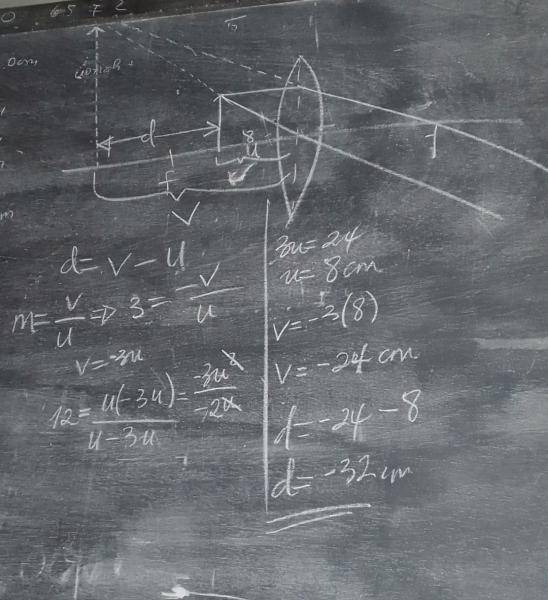
the formula is 1/f=1/u+1/v
the word upright was used therefore it would be v would be negative M=3
M=v/u
3=v/u
v=-3u
1/12=1/u-1/3u
1/12=2/3u
3u=12*2
3u=24
u=8cm
Therefore v=3*8=24cm
Distabce between the object and image =24-8=16cm
So myschool is actually wrong B is the correct answer here

