Which of the following represents the correct precision if the length of a piece of wire is measured with a meter rule?
35mm
35.0mm
35.00mm
35.01mm
Explanation
No explanation available
Video Explanation
No video available
Post your Contribution
Discussions (20)


Metre rule accuracy is 0.1cm converting it to mm is 1mm. No decimal associated with it
The smallest division on the meter rule is 1mm precisely measurements can be made to the nearest 0.5mm
so the answer is B
ref lamlad physics
Meter rule reading accuracy is 1mm or 0.1cm, so the measurements should be 35mm or 0.35cm respectively Options A is correct
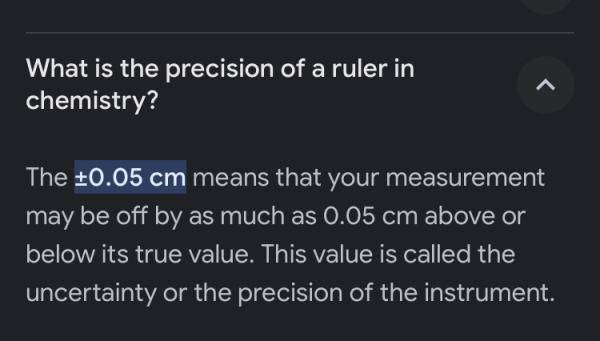
i thought precision is the same thing as estimated uncertainty not reading accuracy

I saw these question before I chose *A* and I failed it now I chose Nother one and I still failed it
A meter rule typically has a smallest division of 1 mm.
So, the precision is ±0.5 mm, and measurements should be recorded to one decimal place in cm or one decimal in mm if expressed carefully.
pls myschool endeavour to make this correction

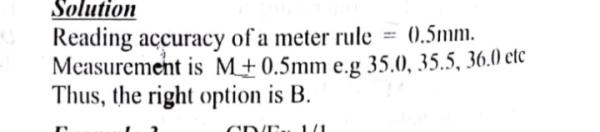

When using a meter rule, the typical precision is ±0.5 mm or ±1 mm, depending on the quality of the rule.
Given this, the correct precision for a measurement of 35 mm would be:
B. 35.0 mm
This indicates that the measurement is accurate to the nearest 0.1 mm, which is consistent with the precision of a standard meter rule.
The other options are incorrect because:
A. 35 mm implies an accuracy of only ±1 mm, which is coarser than what a meter rule can provide.
C. 35.00 mm implies an accuracy of ±0.01 mm, which is finer than what a standard meter rule can provide.
D. 35.01 mm also implies an accuracy that is finer than what a standard meter rule can provide.

