Hot water is added to three times its mass of water at 10oC and the resultant temperature is 20oC. What is the initial temperature of the hot water?
100oC
80oC
50oC
40oC
Explanation
Video Explanation
No video available
Post your Contribution
Discussions (15)

MCT=MCT
ratio of the masses=1:3
Therefore
1CT=3CT
heat change
From 10c to 20c=+10
the loss must be the same value but with opposite signs
3CT lost -10c as 10+(-10)=0(heat lost is equal to heat gained.
back to the formula
1CT=3CT
1(10)c=3(-10)c
10c=-30c
divide both sides by c to cancel it out(c is constant)
10c/c=-30c/c
10°c gained(positive sign)= -30°c lost(negative sign)
10°c to 20°c gained, 30°c lost from 50°c to 20°c.

The answer is wrong bcosNCOs 20°c is the resultant temperature which must be less than the temperature of the hot water..
It is calculated as follows;
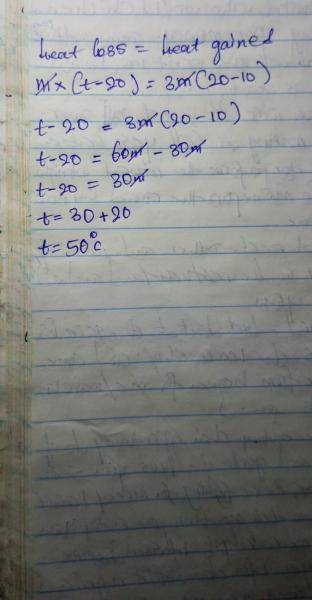
m×c t = m×c×t (heat loss by hot water equall heat gain b water @ 10°c)
3m ×c×(t-20)=m×c×(20-10)
3×(t-20)=10
t-20=10÷3
t=3.3333+20=23.33°c
 -20)=m×c(20-10)
I think the answer is D
Initial temp.=t°c
Mass of hot water=mg
Mass of cold water=10°c
Final temp.=20°c
Rise in temp.of cold water=(20-10)°c
Rise in temp.of hot water=(t-20)°c
Using the principle of mixtures
Heat energy by hot water=Heat energy by cold water.
Given as:
m×(t-20)=3m×(20-10)
(t-20)=2m×(20-10)
t-20c=40m-20m
t-20c=20m
Divide bother sides by c
t-20=20
t=40°c

