A car moving with a speed of 90kmh\(^{-1}\) was brought uniformly to rest by the application of the brakes in 10s. How far did the car travel after the brakes were applied?
125m
150m
250m
15km
Explanation
Video Explanation
No video available
Post your Contribution
Discussions (33)

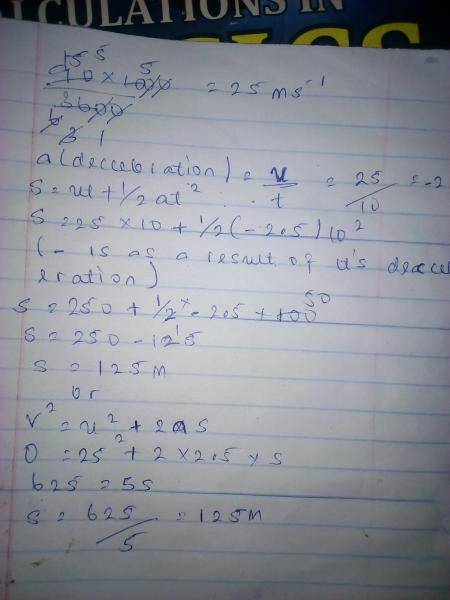
u=90×1000/36000
u=25ms^-1
a(deceleration)=u/t
a=25/10
a=-2.5
S=ut+½at²
S=25×10+½×-2.5×10²
S=250-125
S=125m
OR
v²=u²+2as
0=25²+2(-2.5)s
625=5s
S=625/5
S=125m

If the velocity time graph is drawn, the distance will be the area of a triangle and not a square. This is because it came to REST. The answer, therefore, should be = 0.5 x 10 x 25 = 125m.

Speed of car = 90km/hr
90*1000
= ------------ => 25m/s
3600
But,
Acceleration = 25/10 = 2.5m/s²
Using
S = ut + ½gt²...
U = 0m/s because the was to rest. Therefore, V is max.
S = 0*10 + ½*2.5*10²
S = 0 + ½*250
S = 125m//

V=90×1000/60×60=25m/s
U=0
t=10s
Recall that
S=v+u(t)/2
S=25+0(10) /2
S= 250/2
S=125m
Here is a better way of answering the question
u= 90km/hr = (90 x 1000)÷ 3600 = 25m/s
v=0 , t= 10, S=?
V = u + at
0 = 25 + 10a
-25 = 10a
a = -25/10 = -2.5
S = ut + 1/2 at²
S = 25 x 10 + 1/2 x (-2.5) x 10²
S = 250 - 125
S = 125m
Using V²=U²+2as
V²=0
U²=25²
a=-2.5
S=?
0=25²+2(-2.5)S
625=5S
S=
625/5=5/5
S=125m.
Speed of car = 90km/hr
90*1000
= ------------ => 25m/s
3600
But,
Acceleration = 25/10 = 2.5m/s²
Using
S = ut + ½gt²...
U = 0m/s because the was to rest. Therefore, V is max.
S = 0*10 + ½*2.5*10²
S = 0 + ½*250
S = 125m//
The question doesn't match the answer
The final velocity is 0 and the initial is 25m/s