A body starts from rest and moves with a uniform acceleration of 6 ms \(^{-2}\). What distance does it cover in the third seconds
15m
18m
27m
30m
Explanation
Video Explanation
No video available
Post your Contribution
Discussions (27)

Lol, it's not wrong, it's actually correct
When looking for the distance between seconds
For example the third seconds, we'll use S(3rd second) =ut+ 1/2a(t2-t1)²
That's
S=0+1/2(6)(3²-2²)
To find the third second we'll use the second before it, 2nd second
so
S=3(9-4)
S=3*5
S= 15m 
For those who are still confused.
If in 2 days, a man travels 10km and in three days he travels 20km, the actual distance that he traveled within the third day is 20km - 10km i.e 10km.
This means that within the third day, the man travels an additional 10km.
Also, in the second second i.e 2s
S=ut+½at²
S = ½(6)(2²)
S = 3×4
S = 12m
In the third second i.e 3s
S = 27m (calculated in the same way)
Therefore, the actual distance moved within the third second is 27 - 12
= 15m
S=0+1/2(6)(3²-2²)
To find the third second we'll use the second before it, 2nd second
so
S=3(9-4)
S=3*5
S= 15m
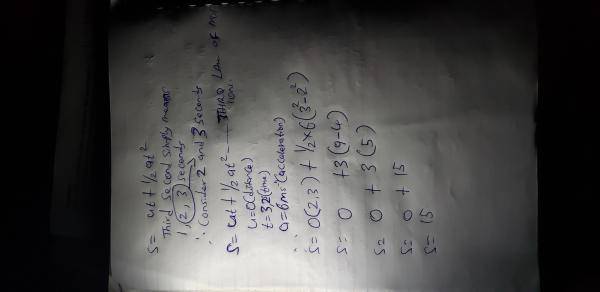
S= ut + 1/2 at²
ut= 0
Distance covered in 3rd or third second is
S= 1/2 x 6 (3²-2²)
S=1/2 x 6 (9-4)
S= 1/2 x 6 x (5)
S=3 x 5
S= 15m



yoi can also use
Sn=a/2(2t-1)
n=2
a=6
t=3
Sn=6/2(2(3)-1)
Sn=3(6-1)
Sn=3(5)
Sn=15m 

You're welcome.




The selected answer is wrong:
a=6ms^(-2)
u=0ms^(-1)
t=3s
S=ut+(1/2)at^2
S=0+(1/2)*6*3^2
S=27m answer
REF: check 3rd equation of motion.

