A weightless vessel of dimensions 4m x 3m x 2m is filled with a liquid of density 1000kgm\(^{-3}\) and sealed. What is the maximum pressure this container can exert on a flat surface? [g = 10ms\(^{-2}\)]
9 x 10⁴Nm-2
4 x 10⁴Nm-2
3 x 10⁴Nm-2
2 x 10⁴Nm-2
Explanation
Video Explanation
No video available
Post your Contribution
Discussions (22)

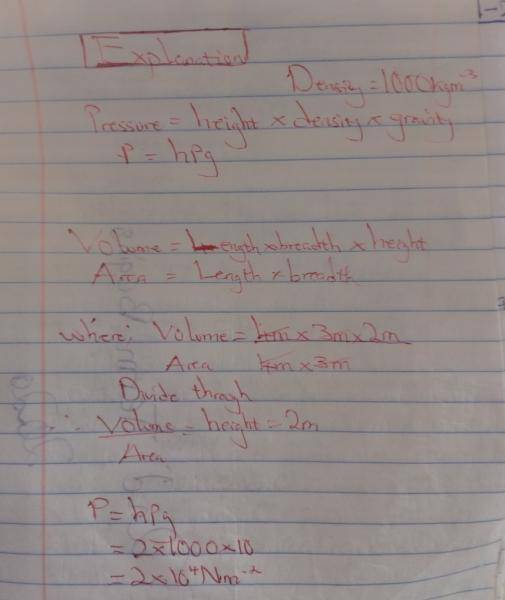

Density=mass/volume
1000=mass/24
Mass=24000kg
Weight=mg=240000N
Pressure =force/area
Max. Pressure =240000/6=40000N/m²
Mini. Pressure =240000/12=20000N/m²

P = ρhg
Recall, pressure increases with depth
The greater the depth the greater the pressure
Hence
h = 4m
g = 10m/s²
ρ(density) = 1000Kg/m³
Maximum pressure = 1000 × 4 × 10
=> 4 × 10^4 N/m²

The question said MAXIMUM HEIGHT and not Minimum Hight.
The option B is super correct
However, for the minimum hight the option D is correct ✅
From the relation;
F=

The correct option is D) 2 x 10⁴ NM⁻².
Here's how to solve the problem:
Understanding the Concepts
* Pressure: Pressure is force per unit area. In fluids, pressure is exerted in all directions.
* Pressure in a Liquid: The pressure at a depth 'h' in a liquid is given by the formula:
* Pressure (P) = density (ρ) × gravity (g) × depth (h)
Solving the Problem
* Maximum Depth: The maximum pressure will occur at the deepest point in the vessel. The maximum depth is 2 meters (given as one of the dimensions).
* Plug in the Values:
* Density (ρ) = 1000 kg/m³
* Gravity (g) = 10 m/s²
* Depth (h) = 2 m
* Calculate the Pressure:
* P = 1000 kg/m³ × 10 m/s² × 2 m
* P = 20000 N/m²
* Express in Scientific Notation:
* P = 2 x 10⁴ N/m²
Therefore, the maximum pressure the container can exert is 2 x 10⁴ N/m², which matches option D.
Volume = 4*3*2 =24m^3
Density = 1000
Maximum pressure =?
But PRESSURE is inversely proportional to AREA
Therefore; MAXIMUM PRESSURE = MINIMUM AREA
minimum area = (the two smallest value from 4,3 and 2) = 3*2 = 6
G =10
Pressure = DENSITY * VOLUME * GRAVITY / AREA
1000*24*10/6 =. 40,000 = 4*10^4
option C.
my school change this already to the correct answer now....🥺
It's B confirm from your Ai....
maximum pressure with the max height or lowest area 🥺

To determine the maximum pressure the container can exert on a flat surface, we use the formula for pressure:
P = F/A
where:
P is pressure,
F is force (weight of the liquid),
A is the area of contact with the surface.
Step 1: Calculate the Volume of the Liquid
The volume of the container is:
V = L x W x H
V = 4 x 3 x 2 = 24 \text{ m}^3
Step 2: Calculate the Mass of the Liquid
Using the density formula:
\text{Mass} = \text{Density} \times \text{Volume}
m = 1000 \times 24 = 24000 \text{ kg}
Step 3: Calculate the Weight of the Liquid
W = mg
W = 24000 \times 10 = 240000 \text{ N}
Step 4: Find the Maximum Pressure
The maximum pressure occurs when the smallest possible area of the container is in contact with the surface. The three possible base areas are:
1.
2.
3. (Smallest area)
Thus, the maximum pressure is:
P_{\max} = \frac{240000}{6} = 40000 \text{ N/m}^2 \text{ or } 40 \text{ kPa}
Final Answer:
The maximum pressure exerted by the container on a flat surface is 40 kPa.
The Ans is B
That means it should lie in a position that the height will be 4m

The highest pressure is at the smallest point not the largest point =2m
P=hpg
P =2x1000x10
{D }

