If a solid X floats in liquids P of relative density 2.0 and in liquid Q of relative density 1.5, it can be inferred that the
weight of P displaced is greater than that of Q
weight of P displaced is less than that of Q
volume of P displaced is greater than that of Q
volume of P displaced is less than that of Q
Explanation
Video Explanation
No video available
Post your Contribution
Discussions (20)

D is the correct answer here.
Your point in the explanation is true but it is not applicable in this question. Here is how the thinking should go
If body X float in liquid P and liquid Q, it means it experienced equal upthrust in both liquids (Principle of Floatation). The upthrust experienced is the weight (mg) of the liquid displaced (Archimedes Principle). Since g is constant in the same location, then, it can savely be concluded that, the same masses of liquid P and Q were displaced. Density = mass ÷ Volume, since Mass is constant in both cases, Density varies inversely as Volume.
Since Liquid P is denser than Liquid Q, Volume of P displaced must be less than Volume of Q displaced.
Option D.
The goal is to understand Principle and know how and when it is applicable. cheers
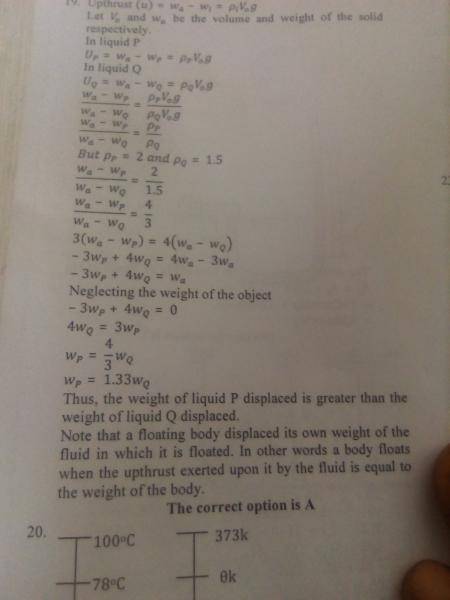
The answer is D
The question sef is straight forward
since the solid floats in both liquids
we use the principle of floatation
upthrust = weight of object
density of fluid*volume of fluid displaced*g = mass of object*g
the mass of solid is constant for both liquids
2*Vp*g = 1.5*Vq*g
therefore Vp:Vq =1.5 : 2 that is Vp is less than Vq
The answer is D even without any relations to formulas bcos a more dense liquid will have little of its volume displaced and as for weight it doesn't change since it is one object floating in two medium
The answer A is wrong
The correct answer is D
Why Not A?
Because:
• Weight of P displaced = weight of Q displaced = weight of the object
• They must be equal since the object floats in both
Final Verdict:
Correct answer is D.
A would only be correct if the object was sinking more in one than the other and somehow displacing different weights — but by Archimedes’ principle, for floating bodies, weight displaced = object’s weight.
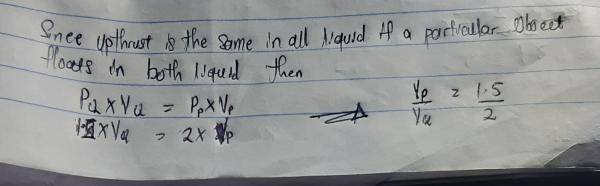

u guys should calms,
in this question, the solid x floats in both liquid and for it to float it experiences an upthrust equal to its weight, therefore the upthrust experienced at both liquid is equal . For the x floating, it volume immersed might be different but wil float if the upthrust equals it weight . This makes D the answer

