If the load at the end of a sonometer wire is immersed in a bucket of water, the original fundamental frequency of the wire could be restored by
decrease the length of the wire
increasing the length of the wire
increasing the mass per unit length of the wire
changing the temperature of the wire
Explanation
Video Explanation
No video available
Post your Contribution
Discussions (24)

OMG 😱, am I the only one seeing this. The answer should be A. Cos length is inversely proportional to frequency. Increasing the length will only decrease the freq the more.
Pls, if you🙋 think 🤔 it's B, Pls explained 🙏👇

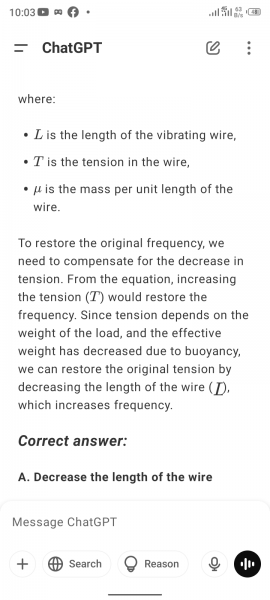
The correct answer is **A. decrease the length of the wire**.
When the load at the end of a sonometer wire is immersed in water, the effective weight of the load decreases due to the buoyant force, which in turn reduces the tension in the wire. This reduction in tension causes a decrease in the fundamental frequency of vibration.
To restore the original fundamental frequency, the length of the wire can be decreased. According to the equation for the frequency of a vibrating string:
\[
f = \frac{1}{2L} \sqrt{\frac{T}{\mu}}
\]
where:
- \(f\) is the frequency,
- \(L\) is the length of the wire,
- \(T\) is the tension in the wire,
- \(\mu\) is the mass per unit length of the wire.
By decreasing the length \(L\), the frequency \(f\) increases, helping restore the original fundamental frequency.



Stop everyone, Let go thru the question together again. The question says: If the load at the end of a sonometer wire is immersed in a bucket of water, the original fundamental frequency of the wire could be restored by?. From the question, it can be derived that with the load being attached to the sonometer, it makes the sonometer to vibrate at its fundamental frequency. then after sometime, the load was immersed in a bucket of water which bring about upthrust (decrease in tension) due to opposite force experienced, the tension in the lessen from the fundamental frequency. Now we are being asked how we can restore the tension in the string back to it fudamental frequency. Simple, all we have to do is to try to pull out the load from the water so the it will escape the influence of upthrust, so the question now become: how can we pull back the load out of the water, by applying pratical sense, this means that we should shorten the lenght of the string the the load we start pulling out till it can no longer experience upthrust again. Then the fundamental frequency is restored.
So the A and not B
try praticalizing this and you will arrive at the same answer
peace!!!
F=½L×√T.....say mass per unit length is constant
T,the tension is provided by the weight of the object over the sonometer bridge
Before being immersed in water, let's assume that
T1 is 400N,F=200hz,L=0.05m
When immersed in water,there is a decrease in the weight of the object owing to upthrust.
This means that the tension t2 is less than the former t1,that is
t2
they are very correct. when the load is decreased, the tension is reduced... now to restore the original frequency, you divide by a smaller length to give a low linear density which will subsequently divide the tension
So...The length of the wire is directly proportional to the resistance. The longer the wire, greater it's resistance. The longer the wire is, more number of collisions occur while the electrons travel from one end of the wire to another. This increases the resistance.
Hope this helps🙂


The frequency of a sonometer wire is directly proportional to the length of the wire. When the load is immersed in water, the frequency of the wire decreases and therefore to restore it back to its original frequency, you increase the length.

