A planet has mass m1 and is at a distance r, from the sun. A second planet has mass m2 = 10m1 and at a distance of r2 = 2r1 from the sun. Determine the ratio of the gravitational force experienced by the planets.
1 : 5
2 : 5
3 : 5
4 : 5
Explanation
Video Explanation
No video available
Post your Contribution
Discussions (13)
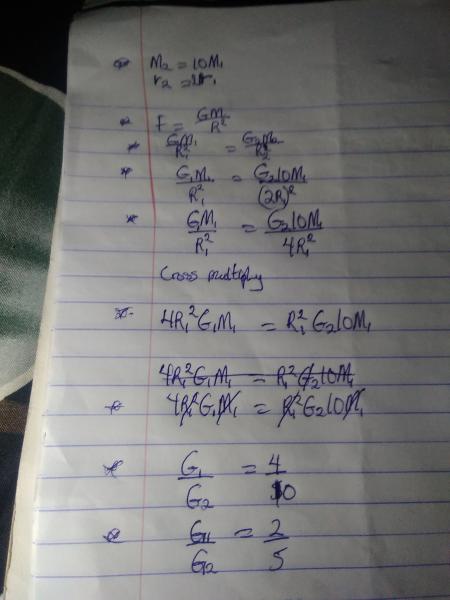
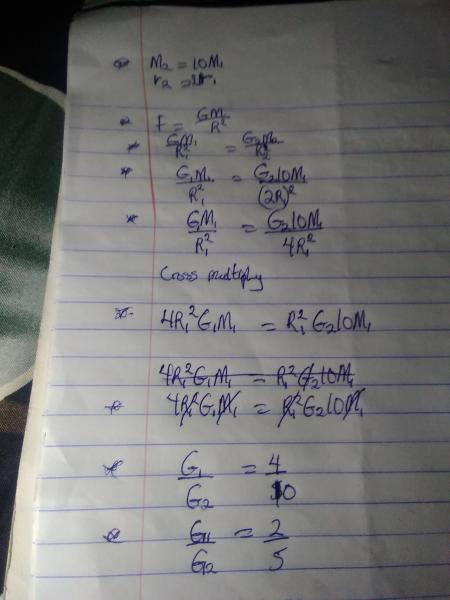
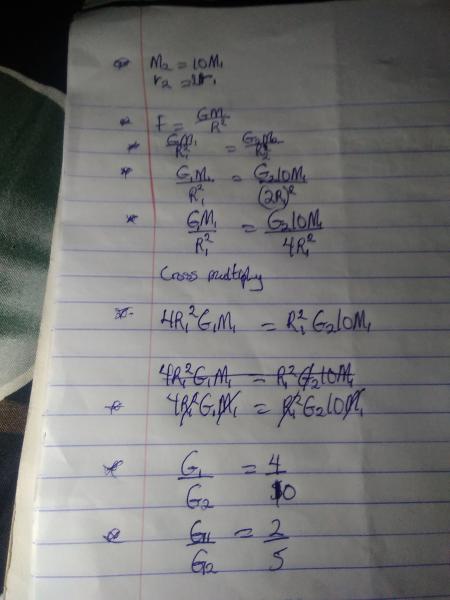

To determine the ratio of the gravitational forces experienced by the planets, we can use Newton's law of universal gravitation, which states:
\[ F = \frac{{G \cdot m_1 \cdot m_2}}{{r^2}} \]
where:
- \( F \) is the gravitational force,
- \( G \) is the gravitational constant (a constant value),
- \( m_1 \) and \( m_2 \) are the masses of the two objects (in this case, the planets),
- \( r \) is the distance between the centers of the two objects.
Let's denote the gravitational force experienced by the first planet as \( F_1 \) and the gravitational force experienced by the second planet as \( F_2 \).
For the first planet:
\[ F_1 = \frac{{G \cdot m_1 \cdot m_{\text{sun}}}}{{r_1^2}} \]
For the second planet:
\[ F_2 = \frac{{G \cdot m_2 \cdot m_{\text{sun}}}}{{r_2^2}} \]
We want to find the ratio \( \frac{{F_1}}{{F_2}} \):
\[ \frac{{F_1}}{{F_2}} = \frac{{\frac{{G \cdot m_1 \cdot m_{\text{sun}}}}{{r_1^2}}}}{{\frac{{G \cdot m_2 \cdot m_{\text{sun}}}}{{r_2^2}}}} \]
\[ \frac{{F_1}}{{F_2}} = \frac{{m_1}}{{m_2}} \cdot \frac{{r_2^2}}{{r_1^2}} \]
Substitute the given values:
\[ \frac{{F_1}}{{F_2}} = \frac{{m_1}}{{10m_1}} \cdot \frac{{(2r)^2}}{{r^2}} = \frac{{1}}{{10}} \cdot 4 = \frac{{4}}{{10}} = \frac{{2}}{{5}} \]
So, the ratio of the gravitational force experienced by the planets is \( 2 : 5 \).
Therefore, the correct answer is:
B. \( 2 : 5 \)



