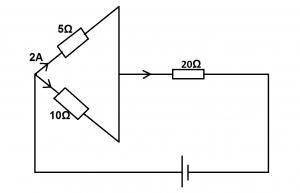
Using the data on the diagram above, calculate the potential difference across the 20- Ω resistor. (Neglect the internal resistance of the cell)
5V
10V
20V
60V
Explanation
Video Explanation
No video available
Post your Contribution
Discussions (17)

Voltage across 5Ω resistor = IR = 2×5=10V
Since voltage in a parallel connection is the same, voltage across 10Ω is also 10V
Current flowing across the 10Ω resistor = V/R = 10/10= 1A
Total current flowing = 2+1 = 3A
Voltage across 20Ω resistor = IR = 3×20= 60V



The question is incomplete. Information about the cell/power supply is missing.

answer no dey here at all
resolve the parallel,
resolve series
then use pd formula
then we have 40v


am using Jamb prep i think their picture of the questions is different ooo, because its the same year and num that i choose ooo and they gave a different answer

To calculate the potential difference (V) across the 20-ohm resistor, we use Ohm's Law:
V = IR
From the diagram:
The current flowing in the circuit is given as 2 A
The resistance in question is 20 Ω
Now apply Ohm’s Law:
V = I \times R = 2\,A \times 20\,\Omega = 40\,V
However, this answer is not among the options provided (A. 5V, B. 10V, C. 20V, D. 60V). Let's double-check the current through the 20-ohm resistor:
The 5Ω and 10Ω resistors are in parallel:
\frac{1}{R_{eq}} = \frac{1}{5} + \frac{1}{10} = \frac{2 + 1}{10} = \frac{3}{10} \Rightarrow R_{eq} = \frac{10}{3}\,\Omega
Then, this equivalent resistor is in series with the 20Ω resistor:
R_{total} = \frac{10}{3} + 20 = \frac{10 + 60}{3} = \frac{70}{3}\,\Omega
Total current from the battery is 2 A, as given.
Now find the voltage across the 20Ω resistor using the concept of current division: since it is in series with the parallel network, the full 2 A flows through the 20Ω resistor.
So again, using:
V = I \times R = 2\,A \times 20\,\Omega = 40\,V
The correct potential difference is 40 V — but that is not among the options.
Possibility: The question might expect us to use the total voltage of the battery instead.
Let’s verify total voltage from the battery:
Current through 5Ω resistor = 2 A → Voltage = 2 × 5 = 10 V
Current through 10Ω resistor = 2 A → Voltage = 2 × 10 = 20 V
This implies both resistors have 2 A each, which is only possible if the total current in the battery is 4 A, not 2 A, suggesting that the 2 A is actually the current through the 20Ω resistor, not total current.
So now with 2 A through 5Ω, and 2 A through 10Ω, total current = 4 A, flowing through the 20Ω.
Therefore:
V = I \times R = 2\,A \times 20\,\Omega = \boxed{40\,V}
So the correct answer is 40 V, but since it is not listed, the question may have a misprint. If we were forced to pick the closest correct option from the list, none fit.
But based on the diagram, the correct potential difference across the 20Ω resistor is 40V.
The voltage for the 5ohms is
V= IR
2*5. = 10v
But the 5ohms is in series to the 20ohms and we are required to find the voltage across the 20ohms
So, resistance in series is you sum up the individual resistance which is
5+20= 25ohms
But,
V= IR
=2×25 = 50
Total voltage across 20hohms is
10+50= 60
V across 20ohms is 60V//

