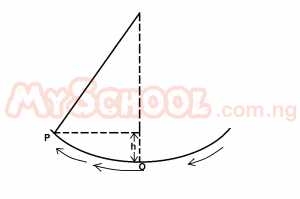
An oscillating pendulum has a velocity of 2ms-1 at the equilibrium position O and velocity at same point P. Using the diagram above, calculate the height of P above O. (Take g = 10ms2)
5.0m
2.0m
0.4m
0.2m
0.1m
Explanation
Video Explanation
No video available
Post your Contribution
Discussions (3)


This physics problem is based on the principles of energy conservation in an oscillating pendulum. The pendulum's velocity at the equilibrium position 𝑂 is given as 2m/s, and we need to determine the height of point 𝑃 above 𝑂.
Explanation
At equilibrium position 𝑂, the pendulum has only kinetic energy. At point 𝑃, all of that kinetic energy is .Using the energy conservation principle, we equate kinetic energy at 𝑂 to potential energy at 𝑃:
1/2 𝑚𝑉2=𝑚gℎ
Canceling 𝑚 from both sides:
1/2𝑉2=𝑔ℎ
Substituting the given values (𝑉=2 m/s,𝑔=10 m/s2):
ℎ=𝑉2/2𝑔=4/2×10
ℎ=4/20=0.2 m
Thus, the height of 𝑃 above 𝑂is 0.2 m, which corresponds to option D.
This approach leverages energy conservation to determine the height—a crucial technique in physics problems involving oscillating systems! Does this explanation help?

