A ball of mass 0.5kg moving at 10ms-1 collides with another ball of equal mass at rest. If the two balls move off together after the impact, calculate their common velocity.
0.2ms-1
0.5ms-1
5.0ms-1
10.0ms-1
20.0ms-1
Explanation
No explanation available
Video Explanation
No video available
Post your Contribution
Discussions (12)

Wen u look @ de Ques. There are two body Masses M1 and M2.M1U1+M2U2. Now, de 2nd Body Mass M2 but de Initial velocity of 2nd Body is "0". U2 is zero, bcos in de Ques dey said at rest, that means de end body is stationary and not moving so its velocity is "0". V(M1+M2).By equating dem together u ave V(M1+M2)=M1U1+M2U2. Let, M1=Initial Mass, M2=final Mass and de Masses are 0.5kg bcos dey are equal mass. Let, U1=initial velocity=10m/s, U2=final Velocity=0 at rest. By substitution u ave V(0.5+0.5)=0.5x10 + 0.5x0> V(1)=5+0> V=5> V=5m/s.

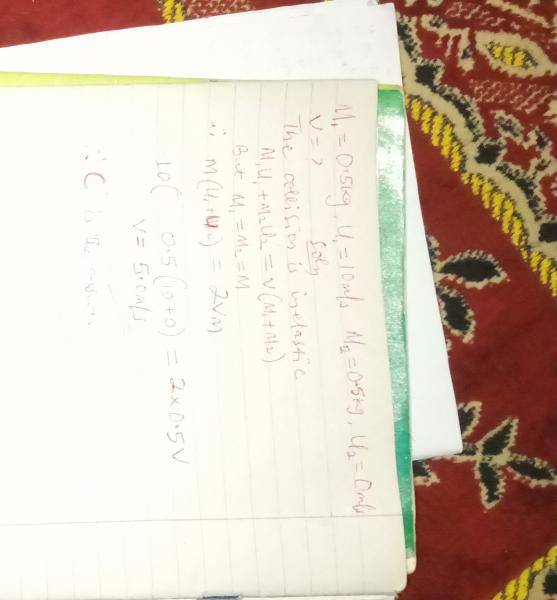
The answer is C
the collision is inelastic.
M1=M2=0.5kg
U1= 10m/s, U2 = 0m/s V1=V2= V
using the formula;
M1U1+M2U2 = V(M1+M2)
0.5×10+0.5×0 = V(0.5+0.5)
V = 0.5 × 10
V = 5 m/s
Formula for collision is stated as m1u1+m2u2 = (m1+m2)v, where v is the common velocity..
so we have: (0.5*10) + (0.5*0) = (0.5+0.5)v
5=v
since the body move together after collision this is inelastic collision therefore the formula is M1V1+M2V2=(M1+M2)V. M1=0.5kg, V1=10m/s, M2=0.5kg, since M2 was at rest V2=0, now we are looking for V. Which is 0.5*10+0.5*0=(0.5+0.5)V. Then V=5m/s option C
M1= 0.5kg, u1= 10m/s, m2 0.5kg, u2 = 0
Total momentum before collision = total momentum after impact or collision
M1u1 + m2u2 = (m1 + m2)v where v = common velocity
(0.5 X 10) + (0.5 x 0)= (0.5 + 0.5) v
V= 5.0m/s option C