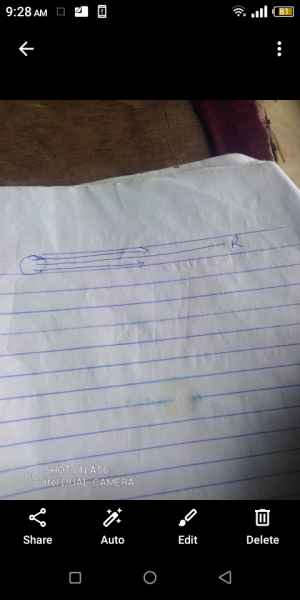
The resultant of two forces acting on an object is maximum if the angle between them is
45°
0°
90°
180°
Explanation
Video Explanation
Post your Contribution
Discussions (12)

Welllll I failed this but I chose 90* because the force is zero when parallel I.e 0* and max at 90* .............pls I nid clarifications

The resultant is inversely proportional to the angle,the lesser d angle d greater d resultant,angle 0 is d ans

Pls don't be confused
NB from the general formulae
R= √A square + B square - 2AB COSo
pick any two simiar number and subtitute into the above and from the general rule when you subtract 180-0 you will get 180 and when you apply cos180 you get -1 for instance if am using 2
(2×2+2×2)-(2×2×2cos180)
NB always subtract 180° from your teata so after subtracting 0 from 180 because (option B) gives you the greatest resultant you answer will be
8-(-8)
because cos 180 is -1
and that will give you 64
Try the rest of the angle and you get 0 and negative value
Thanks

For more clarification using the dot product of two vectors
A•B = |A||B|cos ∆
Therefore for this two vectors to be maximum cos ∆ must be equal to zero

at angle 0°, 2 forces acting on a body are in the same direction,so literally resultant = F1 +F2