The diagram above shows a plank RS pivoted its center of gravity O and is in equilibrium with the weight P and Q. If a weight 2P is added to P the plank will be in equilibrium again by?
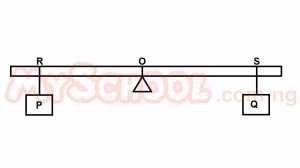
moving Q nearer to O
moving P nearer to O
addding a weight Q to Q
moving P further away from O
Explanation
Video Explanation
Post your Contribution
Discussions (10)

I disagree with this answer if the weight of p increases by 2p therefore 3p so the rule should tilt to the left which is to R therefore Q should move to O

in moment of forces, distance is inversely proportional to the weight or force. So an increase in distance between the force or load or weight and the ends of a metre rule leads to an decrease in the weight along the centre.
In this situation, the plank is initially in equilibrium with weights
𝑃
P and
𝑄
Q balanced at certain points. When a weight
2
𝑃
2P is added to
𝑃
P, the plank will still need to maintain equilibrium, meaning the torques (momentum) about the pivot
𝑂
O must still balance out.
In order for the plank to be in equilibrium again, the torque created by the added weight
2
𝑃
2P on
𝑃
P should be counteracted. The torque is the product of the force (weight) and the distance from the pivot. So, in order to counterbalance the additional weight, we need to:
Either move
𝑃
P nearer to
𝑂
O, which reduces the torque from
𝑃
P, or
Move
𝑄
Q nearer to
𝑂
O to increase its counteracting torque.
The correct answer is A: moving Q nearer to O. This is because moving
𝑄
Q nearer to
𝑂
O would reduce the torque created by
𝑄
Q, balancing the extra torque from
2
𝑃
2P added to
𝑃
P.

