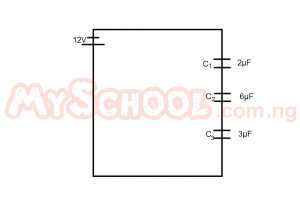
The diagram above shows the capacitors C\(_1\), C\(_2\) and C\(_3\) 2μF, 6μF and 3μF respectively. The potential difference across C\(_1\), C\(_2\) and C\(_3\) respectively are


C = \(\frac{\text{Q}}{\text{V}}\) => Q = CV : ∴ V = \(\frac{\text{Q}}{\text{C}}\)
∴V\(_1\) = \(\frac{\text{Q}}{C_1}\); V\(_2\) = \(\frac{\text{Q}}{C_2}\);
V\(_3\) = \(\frac{\text{Q}}{C_3}\)
for series
\(\frac{1}{\text{C}}\) = \(\frac{1}{C_1}\) + \(\frac{1}{C_2}\) + \(\frac{1}{C_3}\)
= \(\frac{1}{2} + \frac{1}{6} + \frac{1}{3}\)
= \(\frac{3 +1 + 2}{6}\)
= \(\frac{6}{6}\) = 1
∴ C = 1μF = 1.0 x 10\(^{-6}\)F
∴ Q = CV = 1.0 x 10\(^{-6}\) x 12
= 12.0 x 10\(^{-6}\)C
∴V\(_1\) = \(\frac{\text{Q}}{C_1}\)
= \(\frac{12 \times 10^{-6}}{2 \times 10^{-6}}\)
= 6V
V\(_2\) = \(\frac{\text{Q}}{C_2}\)
= \(\frac{12 \times 10^{-6}}{6 \times 10^{-6}}\)
= 2V
V\(_3\) = \(\frac{\text{Q}}{C_3}\)
= \(\frac{12 \times 10^{-6}}{3 \times 10^{-6}}\)
= 4V
∴ 6V, 2V and 4V
There is an explanation video available below.





Contributions ({{ comment_count }})
Please wait...
Modal title
Report
Block User
{{ feedback_modal_data.title }}