Determine the value of x for which (x\(^2\) - 1) > 0?
x < -1 or x > 1
-1 < x < 1
x > 0
x < -1
Explanation
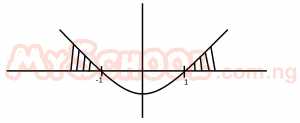
Video Explanation
Post your Contribution
Discussions (43)

(x² - 1) > 0
(x + 1) (x - 1) > 0
x + 1 > 0 and x - 1 > 0
x > -1 and x < 1
Therefore -1 < x < 1
🙂

So for people who didn't understand how we are faactorising, becaue 1 is not squared. Remember, 1 squared is still 1. In this case, 1 could be cubed, or anything. It will always equal 1, so we can use difference of two squares

The correct answer is option A.
Soln:
x² - 1 > 0
(x + 1)(x - 1) > 0 (Diff. of 2 squares, i.e, x² - 1²)
From the above expansion, the product of (x +1) and (x - 1) gives a number > 0 which implies that their product must be a +VE NUMBER. [If a number is greater than 0 it is +ve and if it is < 0 it is - ve.] Only two conditions will satisfy this inequality;
CONDITION 1: (x +1) and (x - 1) are both > 0 i.e, they are both +ve (NB: +ve X +ve = +ve)
CONDITION 2: (x + 1) and (x - 1) are both 0 and x - 1> 0 (both +ve)
x > -1 and x > 1
When we represent this on a number-line, the point of intersection of x > -1 and x > 1 (i.e the range of values contained simultaneously in both lines) is from 'x > 1'.
∴ x > 1 is a solution to the inequality.
(NB: CONDITION 1 only gives us a solution because there is a point of intersection between both lines which is from x > 1. If there weren't a point of intersection between both lines, it wouldn't have resulted to any solution. Consequently, the solution it gives us lies in the point of intersection which is x > 1)
Let's consider CONDITION 2:
x +1 < 0 and x - 1< 0 (both - ve)
x < -1 and x < 1
When we represent this on a number-line, the point of intersection of x < -1 and x < 1 is from 'x < -1'.
∴ x < -1 is a solution to the inequality.
(NB: Like before, CONDITION 2 gives a solution because there is a point of intersection between both lines which is from x < -1)
Combining CONDITIONS 2 & 1 respectively, we have,
x < -1 and x > 1
That leaves us with option A
The correct answer is option A.
Soln:
x² - 1 > 0
(x + 1)(x - 1) > 0 (Diff. of 2 squares, i.e, x² - 1²)
From the above expansion, the product of (x +1) and (x - 1) gives a number > 0 which implies that their product must be a +VE NUMBER. (If a number is greater than 0 it is +ve and if it is < 0 it is - ve.)
Only two conditions will satisfy this inequality;
CONDITION 1: (x +1) and (x - 1) are both > 0 i.e, they are both +ve (NB: +ve X +ve = +ve)
CONDITION 2: (x + 1) and (x - 1) are both < 0 i.e, they are both - ve (NB: -ve X - ve = +ve)
(NB: If either of them is +ve and the other - ve, their product will be - ve and this contradicts our original inequality.)
From CONDITION 1 we have;
x + 1 > 0 and x - 1> 0 (both +ve)
x > -1 and x > 1
When we represent this on a number-line, the point of intersection of x > -1 and x > 1 (i.e the range of values contained simultaneously in both lines) is from 'x > 1'.
∴ x > 1 is a solution to the inequality.
(NB: CONDITION 1 only gives us a solution because there is a point of intersection between both lines which is from x > 1. If there weren't a point of intersection between both lines, it wouldn't have resulted to any solution. Consequently, the solution it gives us lies in the point of intersection which is x > 1)
Let's consider CONDITION 2:
x +1 < 0 and x - 1< 0 (both - ve)
x < -1 and x < 1
When we represent this on a number-line, the point of intersection of x < -1 and x < 1 is from 'x < -1'.
∴ x < -1 is a solution to the inequality.
(NB: Like before, CONDITION 2 gives a solution because there is a point of intersection between both lines which is from x < -1)
Combining CONDITIONS 2 & 1 respectively, we have,
x < -1 and x > 1
That leaves us with option A

I am not too sure of this but since we factoriesd and got (x-1) and (x+1) > 0, should we not have x>-1 and x>1 and that is -1

The person that solved this clearly doesn't know what they're doing considering the fact they also DREW a QUADRATIC CURVE disproving their answer.

The video provided for the solution of the above question is wrong and also the written solution is wrong also. Pls I hope to get the correct solution soon
Thank you

The correct answer is A please. My school, please stop deceiving students. If you are not sure of any answers. Please leave it blank.
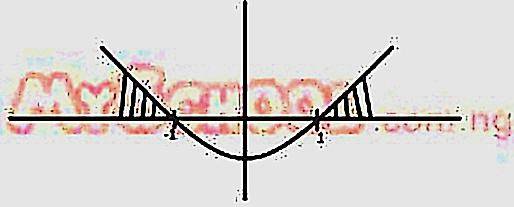
The confusion there is this, look at the diagram [graph] below, the shaded part of the graph is what we need, i.e: the part of the parabola that goes beyond zero on the y - axis. Looking at it clearly you should agree with me that the answer is x < -1 & x > 1, {even when you test this using the inequality given you'll see it's correct.}. This answer can be re-written as -1>x>1, which is not even in the option so the answer should be x < -1 & x > 1, option A.

