A side and a diagonal of a rhombus are 10cm and 12cm respectively, Find its area


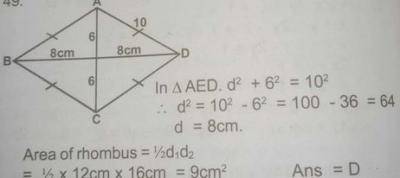
From the diagram above
B\(^2\) = 10\(^2\) - 6\(^2\) = 64
B = \(\sqrt{64}\) = 8 cm( B represent half the second diagonal not given)
So, the second diagonal not given = 8 + 8 = 16cm.
But, Area of a rhombus = \(\frac{1}{2}\) x both diagonals that is, \(\frac{1}{2}\) x d\(_1\) x d\(_2\)
Area of a rhombus = \(\frac{1}{2}\) x 12 x 16 = 6 x 16 = 96cm\(^2\)





Contributions ({{ comment_count }})
Please wait...
Modal title
Report
Block User
{{ feedback_modal_data.title }}