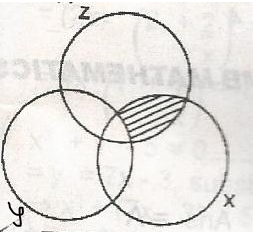
a
x \(\cap\) z
b
xo \(\cap\) y \(\cap\) z
c
x \(\cap\) yo \(\cap\) z
d
x \(\cap\) y \(\cap\) zo
Explanation
Correct Option
cVideo Explanation
No video available
Post your Contribution
Share:
Discussions (10)

nathaniel 246
10 years ago
The selected answer is wrong:
the shaded part is between x and z so it has nothing to do with y
so by that we are to hav our answer as x n z
paulo122
8 years ago
The selected answer is wrong:
The answer is C
XnZ which was chosen doesn't exclude y, which was not shaded
XnZnY'

NTE OKECHUKWU AJAH
8 years ago
option C is the correct answer.
it is easy to see that x intersect y' with U- y and[ x intersect y'] intersect z with the shaded portion expressed as x intersect z "only" which is different from option A that is ordinary x intersect y.


