


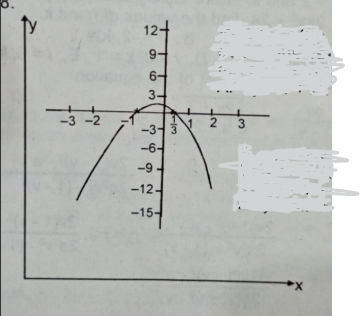
The roots of the function are -1 and \(\frac{1}{3}\)
sum of roots = -1 + \(\frac{1}{3}\) = -\(\frac{2}{3}\)
product of roots = -1 x \(\frac{1}{3}\) = -\(\frac{1}{3}\)
\(x^2\) - (sum of roots)x + (product of roots) = 0
\(x^2\) - (-\(\frac{2}{3}\))x + (-\(\frac{1}{3}\)) = 0
\(x^2\) + \(\frac{2x}{3}\) - \(\frac{1}{3}\) = 0
3\(x^2\) + 2x - 1 = 0( multiple through by -1 since the graph of the quadratic equation is maximum)
1 - 2x - 3\(x^2\).





Contributions ({{ comment_count }})
Please wait...
Modal title
Report
Block User
{{ feedback_modal_data.title }}