m + n = 90o
m = n
n > 45o
m < 45o
Explanation
No explanation available
Video Explanation
No video available
Post your Contribution
Discussions (2)

Based on the geometry problem from the WAEC 1999 Mathematics exam, the correct statement is:
 A. m + n = 90°
Explanation
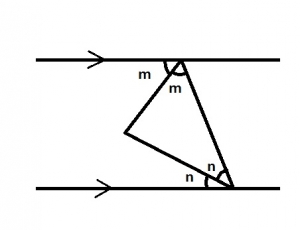
The diagram (which typically appears in this specific past question) depicts a right-angled triangle or a scenario where two angles, m and n, are the two acute angles within a right-angled triangle.
In any triangle, the sum of all interior angles is 180°.
If one angle is a right angle (90°), the remaining two angles must sum to 90° (180° - 90° = 90°).
Therefore, m and n are complementary angles, meaning m + n = 90°.
Why other options are incorrect
 B. m = n: This is only true if the triangle is an isosceles right-angled triangle. Without specific markings indicating the two sides are equal, we cannot assume the angles are identical.
C. n > 45°: While n could be greater than 45°, it is not a "true" statement for all cases of this diagram. It could just as easily be 30° or 40°.
D. m < 45°: Similar to option C, m could be any value less than 90°. There is no specific constraint in the standard diagram for this problem that forces m to be less than 45°.