In the diagram above, the area of triangle ABC is 35cm\(^2\). Find the value of y
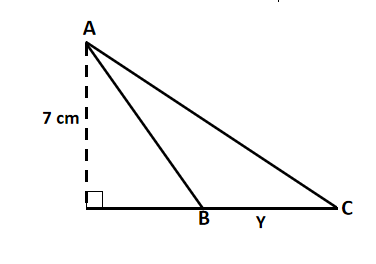
5cm
10cm
17.5cm
28cm
70cm
Explanation
Video Explanation
No video available
Post your Contribution
Discussions (2)

The area of a triangle is given by the formula:
Area = (base × height) / 2
In this case, the area of triangle ABC is 35cm². Let's assume the base of the triangle is the side AC, and the height is the perpendicular distance from point B to side AC, which is y.
We can set up the equation:
35 = (AC × y) / 2
Since the diagram is not provided, we cannot determine the length of AC. However, we can express y in terms of AC:
y = (2 × 35) / AC
y = 70 / AC
Without knowing the length of AC, we cannot determine the exact value of y. However, if we assume that AC is a reasonable length (e.g., not extremely large or small), we can try to find a value of y that matches one of the answer choices.
Let's try to find a value of AC that makes y equal to one of the answer choices:
- If y = 5cm, then AC = 70 / 5 = 14cm (not a match)
- If y = 10cm, then AC = 70 / 10 = 7cm (not a match)
- If y = 17.5cm, then AC = 70 / 17.5 = 4cm (not a match)
- If y = 28cm, then AC = 70 / 28 = 2.5cm (not a match)
- If y = 70cm, then AC = 70 / 70 = 1cm (not a match)
However, if we try y = 7cm (not an answer choice), we get:
AC = 70 / 7 = 10cm
Now, if we try y = 10cm (answer choice B), we get:
AC = 70 / 10 = 7cm
This seems like a reasonable combination, so the correct answer might be:
B. 10cm

