17a. A body of mass 5 kg is placed on a smooth plane inclined at an angle of 30º to the horizontal. Find: the magnitude of the force acting parallel to the plane.
bi. A uniform plank PQ of length 10m and mass m kg rests on two support A and B. Where \PA\ = \BQ\ = 1m. A load of mass 8kg is placed on the plank at point C such that \AC\ = 3.5m, if the reaction at B is 100N. Calculate the value of m
bii. the reaction at A [ take g = 10m/s\(^2\)].


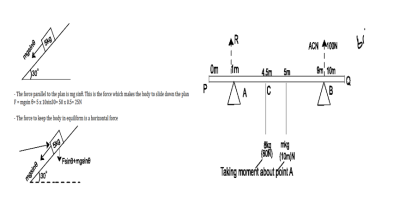
17a. Since the plane is smooth (frictionless), the only force acting parallel to the inclined plane is the component of the weight of the body down the plane.
F = mg sin 30\(^\circ\)
Given m = 5 kg and taking g = 10 m/s\(^2\).
F = 5 \(\times 10 \times \sin 30^\circ\) = 5 \(\times 10 \times\) 0.5 = 25 N.
The magnitude of the force acting parallel to the plane is 25 N.
bi. The uniform plank PQ is 10 m long with supports at A and B such that PA = 1 m and BQ = 1 m. Thus, AB = 8 m. The plank’s centre of mass G is at its midpoint (5 m from P), so AG = 4 m. The 8 kg load is placed at C, where AC = 3.5 m.
Weight of plank = \( 10m \) N
Weight of load = \( 8 \times 10 = 80 \) N
Reaction at B, \( R_B = 100 \) N (given).
For rotational equilibrium, take moments about A (clockwise = anticlockwise):
\((10m) \times 4 + 80 \times 3.5 = 100 \times 8\)
40m + 280 = 800
40m = 520 \(\implies m = \frac{520}{40}\) = 13
Thus, m = 13 kg.
bii. For vertical equilibrium: \(R_A + R_B = \text{total weight}\)
\(R_A + 100 = (10 \times\) 13) + 80
R\(_A\) + 100 = 130 + 80 = 210
R\(_A\) = 210 - 100 = 110 N.
The reaction at A is 110 N.





Contributions ({{ comment_count }})
Please wait...
Modal title
Report
Block User
{{ feedback_modal_data.title }}